Why Chunking Your Content Is Bad for Your SEO and for AI
There's a crowd of GEO Bros who have discovered two words (chunks and embeddings) and decided that the future of SEO is atomizing your site's content.
Their logic goes like this: "since LLMs work with chunks and vectors, let's create ultra-specific URLs for every possible question so the AI can chunk the content better."
The problem is that this advice assumes Google works like a simple vector database such as ChromaDB or Pinecone... and it doesn't.
Today we're going to take this fallacy apart and explain why content consolidated in a single URL still works better (unless the SERP asks you for specificity, as we'll see at the end).
Myth 1: "it used to be ranking, now it's generation"
One of the arguments I see most often lately, pushed most recently by Joshua Budman, is that search engines have stopped ranking and moved on to generating. Which is false.
The pipeline of a RAG system (AI Overviews, ChatGPT...) has three stages. First, the search engine retrieves candidate documents (Retrieval). Then it filters the best ones based on authority and relevance signals (Selection). Finally, the LLM uses those documents to build the answer (Generation).
If your content doesn't make it into the candidate set because it lacks classic ranking signals, the LLM will never see it. It doesn't matter how pretty your chunk is.
In other words, the pipeline is still: Retrieval (Ranking) → Selection (Re-ranking/Filtering) → Generation. If you don't get through the ranking filter, you don't exist for generation, and if you split things up badly, you get cannibalization, duplication and diluted signals thrown in for free.
Also, in his analysis, Budman takes the ranking variables out of the equation. Funnily enough, the original RAG paper he links to does include them. And even funnier, his own Zapier example (the only one he uses to prove his point) shows the pillar page ranking #1 organically, which contradicts his thesis. At least he does admit that in classic SEO the pillar page is still winning... so why make so much noise?
Myth 2: "the length penalty"
People are also arguing that long pages lose mathematical relevance compared to short ones. Let's see how much truth there is to that.
The claim is that BM25 penalizes long documents. In reality, BM25 (an evolution of TF-IDF) introduces a length normalization term (1 − b + b · |D|/avgdl) whose goal is to adjust term frequency based on the document's density, not to punish long documents arbitrarily.
Plus, Google has been using Passage Ranking since 2021 (it was announced in 2020). This means it evaluates individual passages within a page to better understand how relevant the page is. You don't need a short page to be retrievable, because the system already pulls out the relevant passages for you.
Myth 3: "semantic mixing pollutes the embedding"
Another typical oversimplification that keeps popping up is that "if you mix subtopics on one page, the vector becomes impure and the cosine similarity (or dot product) drops."
In production, systems don't represent a complex URL as a single vector. They use segmentation, aggregation, multiple ranking stages, and architectures like Late Interaction (ColBERT) or Google's own systems (RankEmbed, DeepRank) that are trained on click data and human ratings. All of them can handle complex documents without reducing them to a single vector.
Myth 4: "you have to chunk your content for AI"
And here comes the irony, because the GEO Bros tell you to split up your content so it fits better into the chunks LLMs make. But we don't know how they make them. 500-token chunks? 1,000? 20% overlap? Semantic heuristics, or ones based on DOM structure? Nobody knows. You're optimizing for an algorithm you know nothing about.
🔄 Update (January 9, 2026): Danny Sullivan, on Google's Search Off the Record podcast, said exactly this: don't break your content into "bite-sized chunks" because you think that's what LLMs like. And he adds that even if it works for you today, "tomorrow the systems may change". You're putting effort into optimizing for an algorithm you know nothing about, and one that's going to keep evolving.
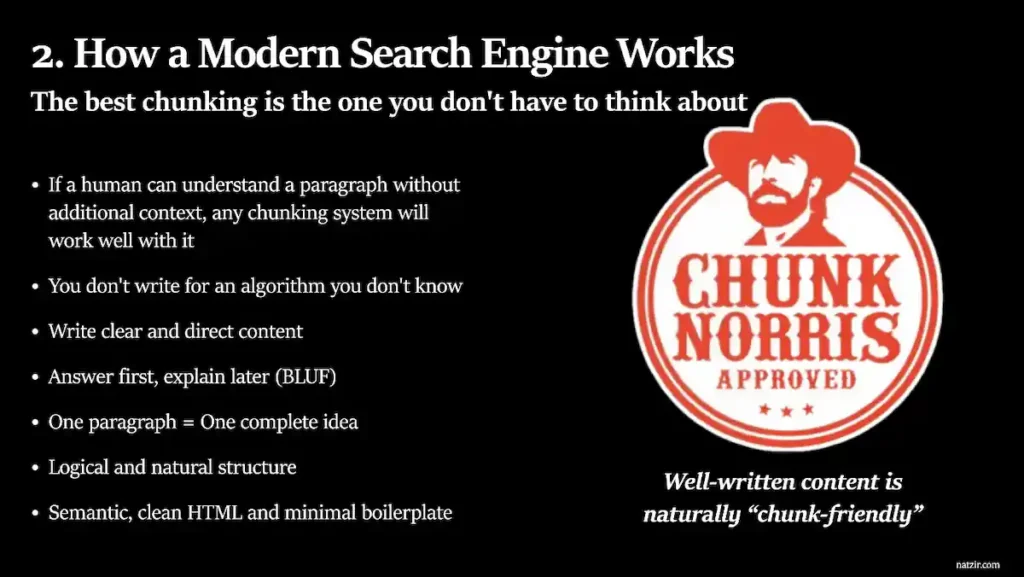
I think the reality is much simpler: if a human can understand a paragraph without any extra context, any chunking system will handle it just fine. Write clearly and get to the point, because the best chunking is the kind you don't have to think about.
To understand why consolidated content works, we need to look at what we think we know about Google's architecture:
Navboost "penalizes" your micro-pages: Thanks to the antitrust trial leaks, we know that Navboost is a user-behavior signal fed by satisfying, long clicks. If you atomize your content, you force users into pogo-sticking: they click in, don't find the full info, go back and look for another result. Your satisfaction metric tanks and Navboost sinks your rankings. Consolidated content keeps users on the page and racks up positive signals.
RankBrain groups intents: RankBrain helps Google understand that different queries share the same underlying intent. When you create separate pages for tiny semantic variations, you're fighting against RankBrain's intent grouping. Google will prefer a URL that satisfies the center of gravity of that grouped intent. I also infer that QBST and Term Weighting are components of RankBrain.
Query Augmentation and "Fan-Out": A recent Surfer SEO study found that pages ranking for the main query plus its fan-out queries (sub-questions) are 161% more likely to be cited in AI Overviews. The takeaway is that this validates good old Topic Clusters... Google uses Query Augmentation (query expansion), so if you have a solid Pillar Page, you cover both the original query and its expansions, lexically and semantically. By consolidating, you maximize your score in systems like RRF (Reciprocal Rank Fusion), which rewards documents that are strong in both vocabulary and topical coverage. And hey, the same goes for ChatGPT and other AIs that do fan-out, as I explain here. Another finding from the study is that 54% of the visible citations in AI Overviews (positions 1-3) rank organically. If you want to be in the citations that matter, you have to rank first.
Information Co-Location in deep search agents: Google's SAGE paper (January 2026) looks at how Google trains its agents for complex search tasks. Looking at the generated questions that turned out to be too easy, they found that in 35% of cases the information needed was co-located in the same document, so the agent needed fewer searches than planned. In another 21%, a single query pulled in information from different documents and collapsed several steps. Consolidating semantically related content reduces search complexity for agents and makes them more likely to use you as a source.
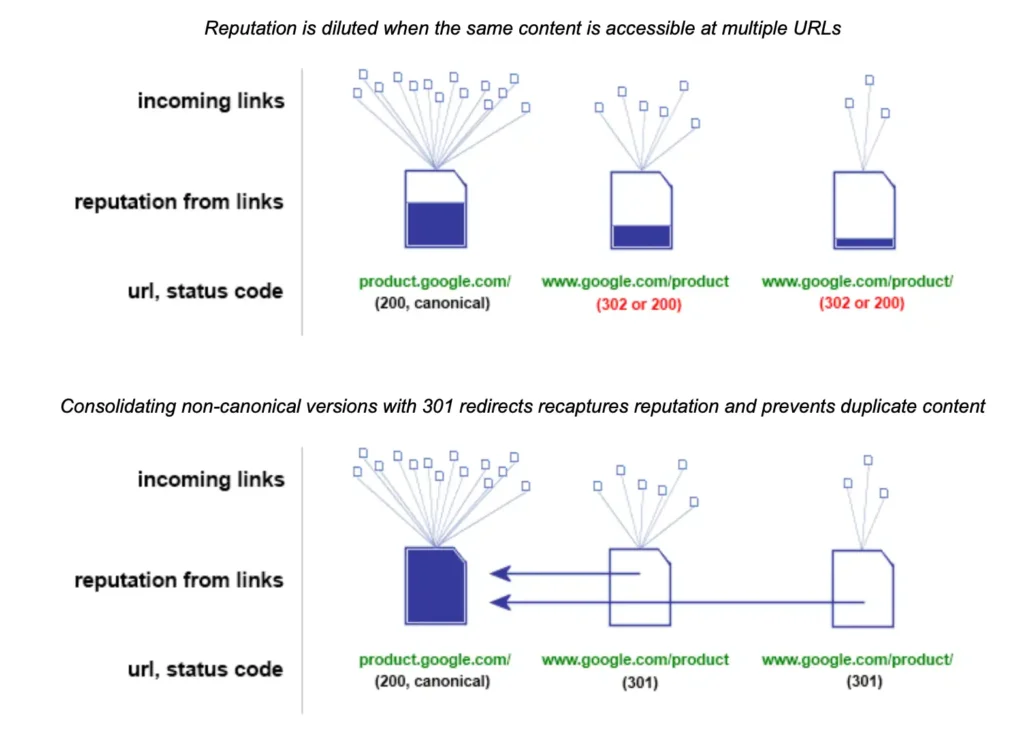
When you split a topic into five pages with overlapping content ("What is X", "Benefits of X", "How to use X"), LLMs tend to group similar URLs together and pick just one to represent them. They often pick the wrong one. Meanwhile, your links, clicks and authority get split across five weak URLs instead of being concentrated in one strong one.
Bing wraps up the article by saying that for SEO and AI, less is more.
So, what should you do today?
I'm not advocating Pillar Pages across the board. What I advocate is consolidating when the SERP (once users have reordered it) calls for it.
My rule is to analyze the SERP for similar queries. Does Google show different results than it does for the general query?
If yes, create a specific page, because the intent is different.
If no, or they mostly overlap, consolidate.
Keep in mind that consolidating without UX is suicide. Defending consolidated content doesn't mean defending a 5,000-word "wall of text" that's impossible to navigate.
If your topical authority gets you ranking for a very specific query (e.g., "which has the better camera, phone X or phone Y"), but the user lands at the top of your mega-guide and has to scroll manually for two minutes to find the answer, they're going to leave. And that's when Navboost will kill you, just as if you had a thin page.
For the consolidation strategy to beat the specificity of micro-pages, your content needs flawless information architecture that allows the answer to be retrieved instantly:
HTML anchors and ToC: Essential. Not just so users can navigate, but so Google can understand the structure and trigger Scroll-to-text-fragment (taking the user straight to the highlighted paragraph).
Visual modules and semiotics: Users don't read, they scan. If your section is about "Cameras", use camera icons, bar charts or visual comparisons. The brain can identify an image seen for just 13 milliseconds. If the user sees a "vs." section, a camera icon and a table with "green checkmarks", they know that's where the conclusion is without having to read anything.
Tables and lists > paragraphs: If you're comparing specs, a table is infinitely more efficient (for humans and for LLM data extraction) than three paragraphs of prose.
Direct-answer design: If a section answers a specific question, get to the point. Put the answer in the first 2 lines of the section. Don't beat around the bush.
If you get this right, you get the best of both worlds, and the chunk's immediate intent resolution will earn points for your Pillar Page.
So stop optimizing for an imaginary, outdated vector database. Users don't want to visit five pages to understand one concept. Search engines don't want to waste resources crawling duplicates. And RAG systems need authoritative sources that have already made it through the ranking filter.
Optimize for the reality of hybrid search engines, with strong signals, consolidated authority and user satisfaction.
SEO based only on keywords is a thing of the past, and the arrival of AI has sped up that shift. Today, search engines have AI built in, and that means fewer clicks end up on your website. AI might be a threat… but it's also a huge opportunity for your small business. Everything has […]
MUVERA (Multi-Vector Retrieval Algorithm) is a Google research paper published on arXiv on May 29, 2024. Its goal is to make multi-vector semantic retrieval (like the kind ColBERT uses) more efficient by turning it into a single-vector retrieval problem, using a technique called Fixed Dimensional Encodings (FDEs). In other words, it's a technical proposal to […]