I always say it's better to swim with search engine algorithms than against them, and this post is a good example of that. In it I'm going to explain the concept of “crawl frequency” and why optimizing it is so vital (especially on large sites) for improving organic traffic.
Understanding crawl frequency
As Google explains in the Crawling and Indexing section of Inside Search: “Computer programs [meaning Google's algorithms] determine which sites to crawl, how often, and how many pages to fetch from each site.” In other words, every page is assigned a crawl budget or crawl rate which, as Matt Cutts explained in 2010, is roughly proportional to the page's PageRank (authority).
This isn't a new term, but sadly very few SEOs know about it. Or rather, it's not so much the term itself they don't know as the impact that optimizing crawl rate has on growing organic traffic.
As we've seen, sites are assigned a crawl budget that depends on the site's authority, but also on how easy the page is to crawl and on its quality. There are a number of obstacles that bots like Google's hate because they make them burn a huge amount of resources, so your crawl rate ends up getting cut. These include:
- hard-to-reach URLs
- a high percentage of useless or ineffective URLs (poor on-page UX, little traffic per URL, duplicates…)
- a high percentage of URLs with errors (4XX, 5XX) or too many 3XX.
- page HTML download times above 500ms.
So our job as SEOs is to make Google use fewer resources, and if we help it, it will reward us. Because even though Google could crawl and index every page on your site, it reserves the right not to if it decides your site doesn't deserve it:
The best pages get crawled more
Everyone knows that Caffeine sped up crawling and indexing for new content, but what most people don't know is that it also keeps the best pages in Google's index fresh. Google knows perfectly well what an effective URL is, and it makes sure to crawl it more because it's a page it always wants to keep up to date in its index. This happens thanks to Percolator, the system that has handled this mechanism since Caffeine (here's the paper: Large-scale Incremental Processing Using Distributed Transactions and Notifications).
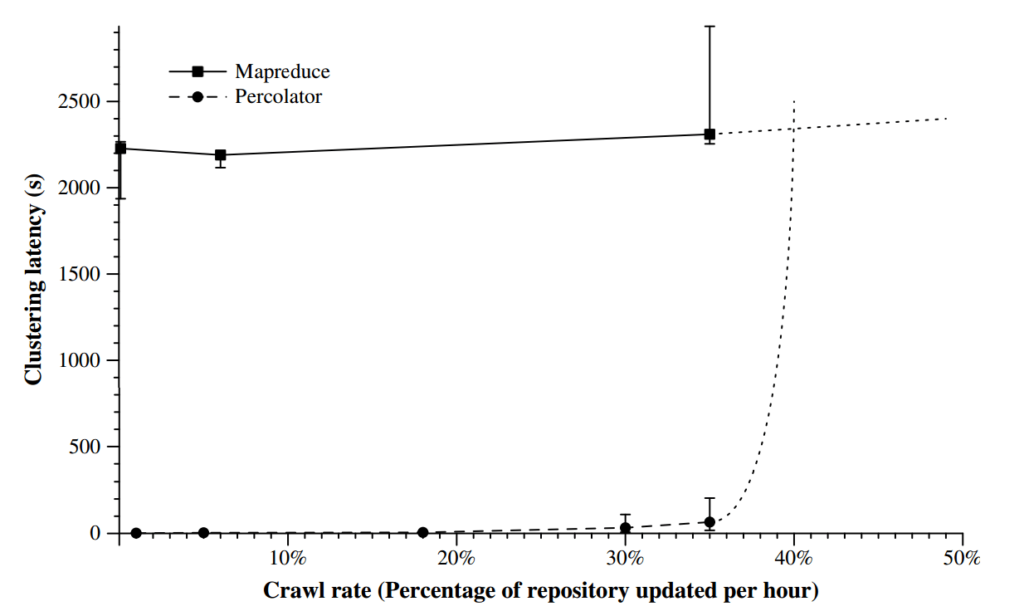
If you look at Google's hits on your site in your logs, you'll see that the sections that get crawled less get less traffic, and the other way around: the sections that get crawled more get more traffic. You might think that's because they're pages with more internal links and more external links, but that's not always the case. Besides being something the patents describe and Matt Cutts has explained in interviews, I've seen this behavior more than once with my partners at FunnelPunk (Daniel Pinillos and Lino Uruñuela). We've come across sections that, without being the most linked, tend to be the ones that get the most organic traffic, and they get crawled more often than the rest. We ourselves have improved our clients' rankings for URLs in their effective sections by increasing the crawl rate to them. So how do you get a page crawled more? By blocking access to the ineffective ones, making pages download fast and keeping the percentage of URLs with errors low. Here's an example of the organic traffic for one of the verticals of a directory site that launched with all its facets open, allowing combinations that created duplicates and thin content:

At first everything goes well and there's an organic traffic boost, but the moment Googlebot gets tired of crawling junk pages, it automatically cuts the crawl rate and filters you out. One of the reasons behind Google Panda is to make Googlebot use fewer resources by filtering out sites with junk content. Don't forget that.
How to optimize your site's crawling
If we want effective pages to be crawled more, we need to:
Have one URL per search intent
with the rest blocked, unless there's a lot of search volume and it doesn't cause cannibalization.
Avoid “canonicalitis” and “noindex, followitis”
These directives don't block the bot's access, so they keep eating up its resources. And using “noindex, nofollow” has always been a load of complete nonsense. Although, as always, it depends on the case, the best option is to nip it in the bud with disallow. Here's another example of too many useless URLs, with Google itself complaining through a warning in Search Console.
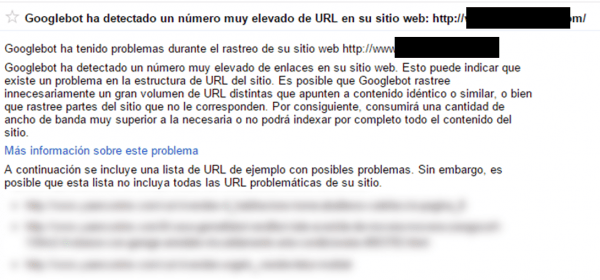
After getting that warning and looking at the sample of URLs it showed us, here's what we did to recover the site: first, we removed all the duplicate sections straight away via robots.txt, and second, we 301-redirected the badly translated content in other languages to subdomains while the translations were being finished (if we had used noindex, follow, we would have killed off a share of pages that mattered to the business). And right now I'm about to deindex 80% of an ecommerce client's URLs via robots.txt (around 400K duplicate facet URLs) that have only brought in 1.4% of organic traffic.
Keep the links you want crawled always accessible
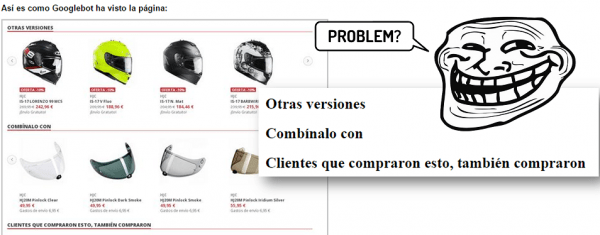
Always check your pages in Google's text-only cached version (or browse them with Lynx), and don't rely on fetch & render for this (look at the image).
Be careful with parameters (query strings and session IDs). A site with 10K final URLs could easily generate a million of them (often because of pagination, which makes the possible combinations grow to infinity). For parameters, it's much better to use # than ? whenever you can, to save the bot work, because it doesn't crawl URLs with #.
Keep pagination to a minimum
Try to put more products on listing pages (but don't let it hurt load time). Test what uses the fewest resources without messing up your SEO: rel next/prev, disallow in robots.txt, view all, or try different combinations of these directives and/or apply them only to certain pages in the series (e.g., only leave the first 3 pages of the series).
Link internally to final pages
In your information architecture (IA), don't link to pages that have a rel=canonical pointing elsewhere or that redirect. Always link to canonical pages that return a 200 status.
Keep your site's errors and redirects under control
Anything that isn't a 200 OK makes Google waste time on pages that don't exist or that sit behind several redirects.
Have a good information architecture
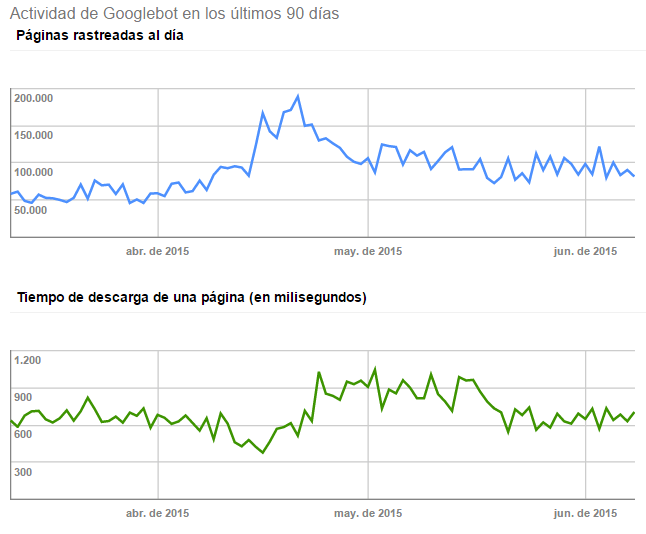
To do this, try to get an IA that's 3 levels deep from the home page (which is not the same as the number of directories). If you can't, lean on HTML sitemaps and organization systems to shorten the distances. It's also very useful to boost the areas that matter to the business (link sculpting). In the next image you can see how, a month after improving a site's IA, the crawl frequency stabilizes and ends up double what it was before (with download times unchanged).
Make your pages download fast
Here you need to distinguish between a page's download time for the bot and its download time for the user. For example, a page can take 200ms to download for the bot and 20 seconds for the user. Try to keep TTFB (Time to First Byte) no higher than 500ms (which is hard with SSL). In the next image, Googlebot loves the first set of TTFB times, while the second set is a crime.
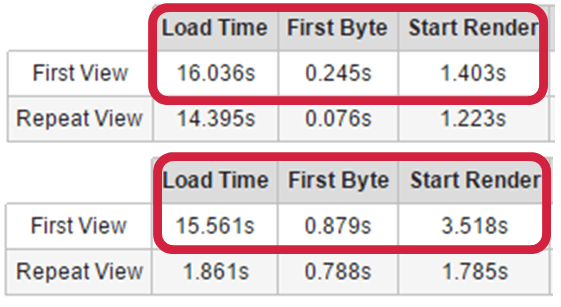
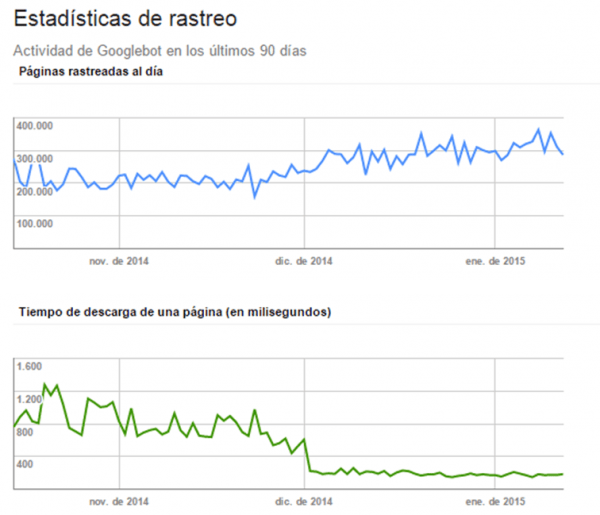
The direct SEO impact is how long it takes the bot to read a page, because that affects crawling (TTFB + download). Download time for the user, on the other hand, also has an impact on SEO, but not a direct one. When performance is bad for the user, the chances of them bouncing back to the SERP are very high. This is called pogo-sticking, and pogo-sticking matters more than CTR for ranking in Google. Since there's no long click and no second click, Google considers that page's UX negative and takes it into account in its machine-learning process, which is based on data from SERP users. That said, Google is stricter on mobile than on desktop and could include TTI (Time to Interactive) in its mobile ranking factors, but we don't know that yet. In the next image you can see how crawling goes up when the page's download time for Google improves:
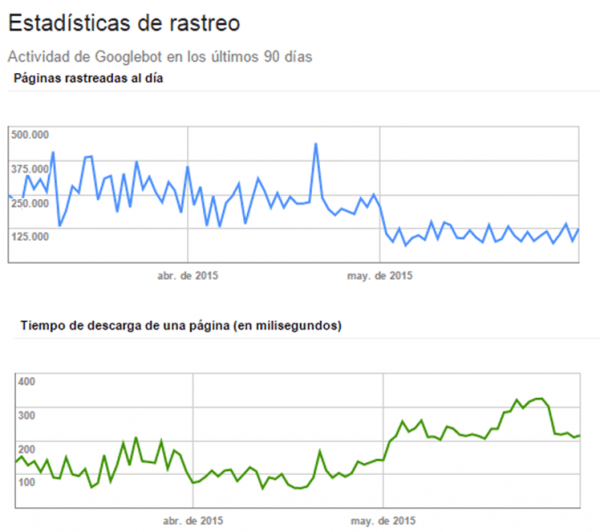
And here's what happened when a synchronous script was added to that same page: the crawl rate went straight to hell and, as a result, organic traffic dropped:
Analyze Googlebot's logs before making a decision
The next image shows one of the reports we put together for our clients. It shows how many URLs in each section of the site Googlebot has accessed, and how many of them users have reached from Google. In red you can see the URLs with a very poor ratio, which means they're URLs Google has but that aren't useful to users. The first thing you might think is that they're not optimized enough on-page, but no: these are sections that are very similar to others that already exist on the site (this example is from a different directory site).
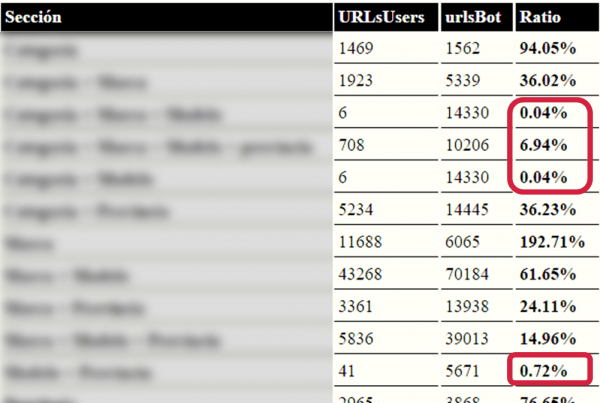
In this case, if you block all these duplicate URLs, you automatically increase the crawl rate of the good ones. Not only that, you'll also get Google to reach the pages it couldn't get to before because of the crawl rate it had been assigned. So you'll gain traffic not just from better crawling, but also from having more effective pages in Google's index (in this case they nearly doubled):
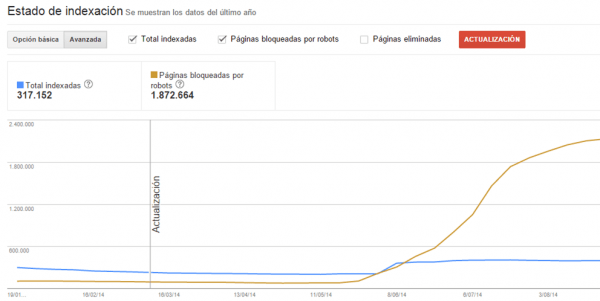
When you build a site from scratch, it's easier to plan an architecture without duplicate content issues and with everything covered here. The problem comes when you're dealing with sites that are already built and you have to change things with surgical precision, because any wrong decision (especially with robots.txt involved) can cost you dearly. If in doubt, the best thing is to contact me or any other SEO with experience in this kind of work.
Conclusion
As I said at the beginning, an SEO's job is to help search engines use as few resources as possible, and that ranges from making your pages easy to ‘understand’ to making sure they make good use of the little time they spend on your site. If you want to learn a bit more, here are the talks Daniel Pinillos, Lino Uruñuela and I gave at Congreso Web, a web conference in Zaragoza, Spain. I recommend buying the streaming videos to understand it all better!
