Search engine algorithms evolve as people's needs evolve. In the beginning, the only way to organize information was through directories. Who doesn't remember what searching on Yahoo was like?
The search engine revolution came when Sergey Brin and Larry Page managed to build an IR algorithm that ranked pages by the number of links they received and gave them to you in a list of 10 results. Google was born thanks to this PageRank breakthrough.
Little by little, search engines adopted this system and added other IR algorithms in parallel (or rewrote the core outright). For example, there were algorithms focused on pages and their relationships (like HITS, TrustRank, Okapi BM25, tf-idf…), then ones moving toward content and quality (the NLP ones: LSI, LDA, spamdexing detection…), and finally ones that reached entities (with AuthorRank, the Social Graph…).
Until now, we've been living in a world of 10 blue links where, to find the information you're looking for, you have to read the text snippets and, with a bit of luck, you find the answer to your questions. For a long time this has been (and still is) a good solution, but it's not enough for users whose needs keep evolving (shorter searches on mobile, more local searches, voice searches…).
The main problem is that it's very hard for a search engine to capture the user's real intent behind a search and return the best result. And this problem gets even harder for algorithms to solve when we talk about searches for entity names and the intent behind them.
What is an entity?
Very simple: an entity can be a person, a place or a thing. And these entities can be associated with dates, actions or other entities.
Today, a very significant share of searches are entity names (20-30% according to a Microsoft study), and an even bigger share are searches that contain entity names (71% according to the same study). As I mentioned before, it's hard for a search engine to detect the intent behind a search for an entity. Below is an example of the most common intents behind different types of entities:
Most common intents for certain types of entities
Even for searches containing entity names where the intent should be clearer, users choose different types of results. In the next image we can see a real example of the intents behind 4 different types of searches that contain the entity “Seattle”:
Percentage of users choosing different results for four different searches that contain the word “Seattle”
Another problem we run into is that entities can be referred to by more than one name, or the same name can refer to different entities. For example, the entity “Barcelona” can refer to the Spanish city, the football club and, to a lesser extent, the city in Venezuela. On top of that, the Spanish Barcelona is commonly known as the “Ciudad Condal” (the “City of Counts”).
Here's a video from the creators of Metaweb (the company behind Freebase) that explains it perfectly:
Entities and search engines
The major search engines are constantly developing and testing different solutions to meet users' needs when they search for an entity name. For example, as soon as you land on Yahoo, there's a section showing the “most searched” terms, and interestingly, most of those search queries are entity names.
Most searched on Yahoo
Google uses the Knowledge Graph (KG, or “the Wikipedia copy” to its friends) to meet these needs. For the query “Barcelona”, we can see that the main task users come to do is more about football than culture or tourism, but the second one is still included because it carries weight:
Google Knowledge Graph for the query “Barcelona”
Bing also has its own KG, but if it isn't sure, it doesn't show it to you. Instead, it offers related queries in the sidebar before showing it.
So, for search engines to give the most popular specific answers, or to help users complete their original task, they don't just need to capture the intent, but also the relationships between entities. For that, the information has to be extracted, connected and stored somewhere. And the most efficient way to do that is with graphs.
From the Knowledge Graph to the Knowledge Vault
The graphs that exist today, and that search engines feed on, are Freebase, DBpedia (which extracts entities from Wikipedia), Facebook Entity Graph, YAGO, OpenIE and many other general and specialized ones (IMDb…). They don't use just one. Google, for example, matches up all the available structured, semi-structured and unstructured information in a Knowledge Vault to reduce the number of errors in the results it returns (because the repositories aren't completely accurate and contain duplicates and errors).
Crowdsourcing to build the Knowledge Vault
Freebase has 637 million non-redundant facts. With this and other sources, Google has built a Knowledge Vault of 302 million facts with a probability of being true above 0.9 (about 74% of them, 223 million, come from Freebase).
Comparison of knowledge repositories
This crowdsourcing of sources and different extraction methods increases the probability of giving a good answer (an AUC score of 0.927):
AUC score improvement from adding different extractors and fusing them
To build the Knowledge Vault, the extractors used to build the information triples and improve the probability of a correct answer are:
Tutorial on Constructing and Mining Web-scale Knowledge Graphs, New York, August 24, 2014
Stanford Seminar – Knowledge Vault and Knowledge-Based Trust
What this means for SEO
The SEO's job will stay the same as always: spoon-feeding information to Google. Our job is to make pages more relevant and structure the data so search engines understand our site. For example, for Google we use microformats or microdata (although Google recommends microdata, microformats work better for me), and for Facebook, RDFa and Open Graph. But there's also RDFa Lite and JSON-LD.
Disambiguate entities
Since the search engines' job is to extract the entities that exist implicitly (text analysis) and explicitly (structured data) using “Data Janitors” (or the “Juanitos”, as Alberto Talegón calls them, a pun on “janitors” using the Spanish name Juanito), working on structured data alone isn't enough when we talk about entities and semantic optimization. One of the main problems Data Janitors have is disambiguating entities, so we need to do that work for them. I've been doing entity disambiguation for a while now, and the results are amazing.
Use knowledge graphs
Since we know that search engines use graphs to deliver better results, we can use them to add our information if they don't have it yet. Google bought Freebase in 2010, so if you're not on it, hurry up and add your information, your company and your products, and connect it to your social graph. And if you're already there, check how you show up, fix any incorrect information and add as much new information as you can (note: if Freebase pulled the information from another source like Wikipedia, you won't be able to edit it in Freebase; you'll have to edit Wikipedia). And let's not forget Google+, which is basically Google's Freebase for people and businesses, so it's still useful in that respect.
You could say that if you're in these knowledge graphs, you're already part of the algorithm, and this makes even more sense now that Hummingbird has arrived. If you don't exist in the Knowledge Vault, you don't exist as an entity, and you're irrelevant to an increasingly semantic search engine.
Structure your data
When it comes to markup, the SEO impact is direct for images and videos, ecommerce, News (through authorship), local results and personalization (social graph). And, as everyone already knows, Google also uses markup in the SERPs through rich snippets, which affects the visibility and CTR of your results. When you're detected as an entity, it directly affects your brand awareness thanks to the extra visibility in the KG.
But SEO isn't just about Google. Structuring your data can be useful for voice search engines like Siri, Evi and Cortana, map search engines and navigation systems, and other kinds of entity-based search engines. As you can see, entities are in practically everything, and they'll be in even more things as semantic search advances.
Focus even more on the user
We also need to put special emphasis on the user, as I explained at the Clinic SEO event in Barcelona. I just can't picture doing SEO without mapping queries (entity/keyword + intent) to content. Above all, I recommend that your keyword research includes user research with specific search tasks on the search engine itself to better understand users' needs. Keywords don't die with entities; they're still necessary.
We could sum up the SEO's job in semantic search in 5 steps:
Find the queries that meet the user's information needs.
Map entities and intents to our content.
Add these entities visibly on the page (implicit), avoiding ambiguity.
Add semantic markup to these entities (explicit).
Add the entities to the repositories if they're not there, and fix the incorrect ones.
Tools to see the entities on a website
How to see explicit entities
To see the structured data added to a site, we can use these free Chrome extensions:
I recommend using as many as you can, because each one uses a different repository, and depending on how clean the data is, it'll give better or worse results. Also, some work better than others depending on the language.
If we want to do more powerful stuff with their APIs, we'll have to pay (there's nothing wrong with paying to use things :P)
Implicit entity audit
If I want to rank for “SEO and HTTPS” and those entities and their related ones don't appear in the article, that article isn't semantically relevant. Below is an example of the entities in my previous post on SEO and HTTPS, using AlchemyAPI:
Entities in the article “SEO, HTTPS and Misinformation”
Then we can use KwMap (edit: this tool no longer exists) to find related entities and keywords. For “HTTPS”, KwMap shows me the following, which I can use to enrich the article:
Keyword Map for “HTTPS”
My advice: don't just stick with the closest ones. Do the same exercise with the ones around them to find new related terms, because that's how Data Janitors work when they classify information. For example, for “HTTPS” I get “SSL” as a close one, and for “SSL” I get “SSL certificates”, which didn't show up at first.
Another thing we can do to check entities (which my friend and business partner Daniel Pinillos reminded me of) is look at Content Keywords in Google Webmaster Tools. If the entities related to your business (and the ones related to them) don't show up there, that's a bad sign. Here we can see an example of a distance learning site that isn't relevant at all:
Entities in Google Webmaster Tools
Entity patents from the major search engines
To wrap up, for those of you who want to dig deeper, here's a list of some entity patents you can learn a lot from. I've personally read several of them, and it's like stripping the search engine bare. And above all, I recommend Bill Slawski's blog on patents. Because if you don't know how search engines work, you're not an SEO.
When a search engine needs to find information, it can try to understand you in two ways: by interpreting the abstract meaning of what you're asking for, or by looking for the exact words you used. Both approaches are powerful, but incomplete on their own. In this article we'll look at what hybrid search is […]
A semantic search engine isn't one that gives you links ranked by relevance, authority and all that stuff. A semantic search engine is one that answers your questions. The Web itself is an interesting paradox: it's built with technology, but its purpose is to solve people's problems. The sites we visit every day use natural […]

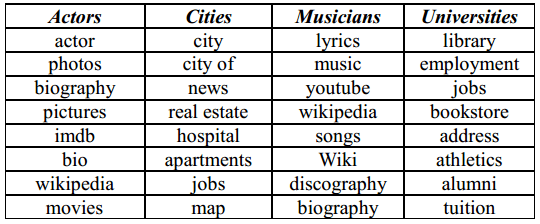 Most common intents for certain types of entities
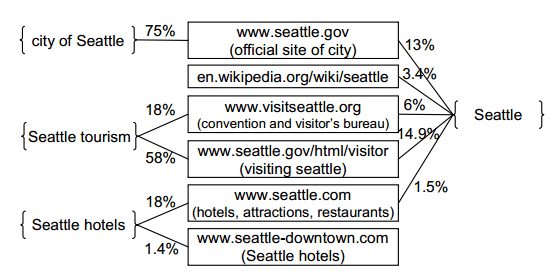 Percentage of users choosing different results for four different searches that contain the word “Seattle”
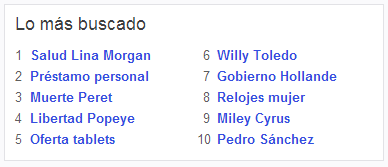 Most searched on Yahoo
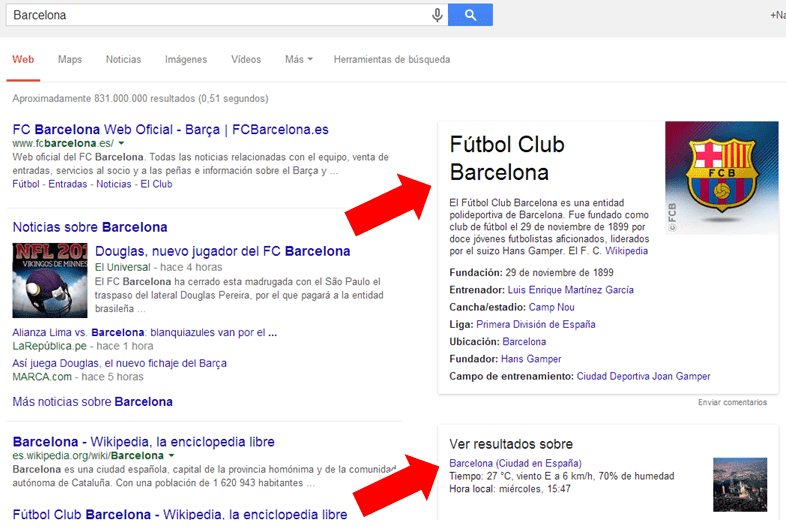 Google Knowledge Graph for the query “Barcelona”
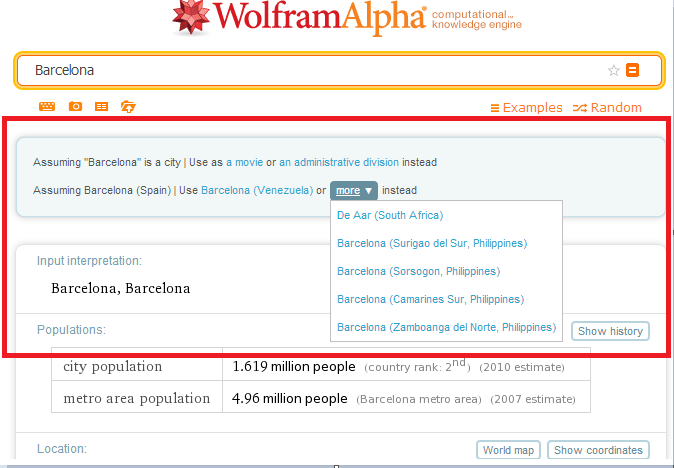 Wolfram Alpha for the query “Barcelona”
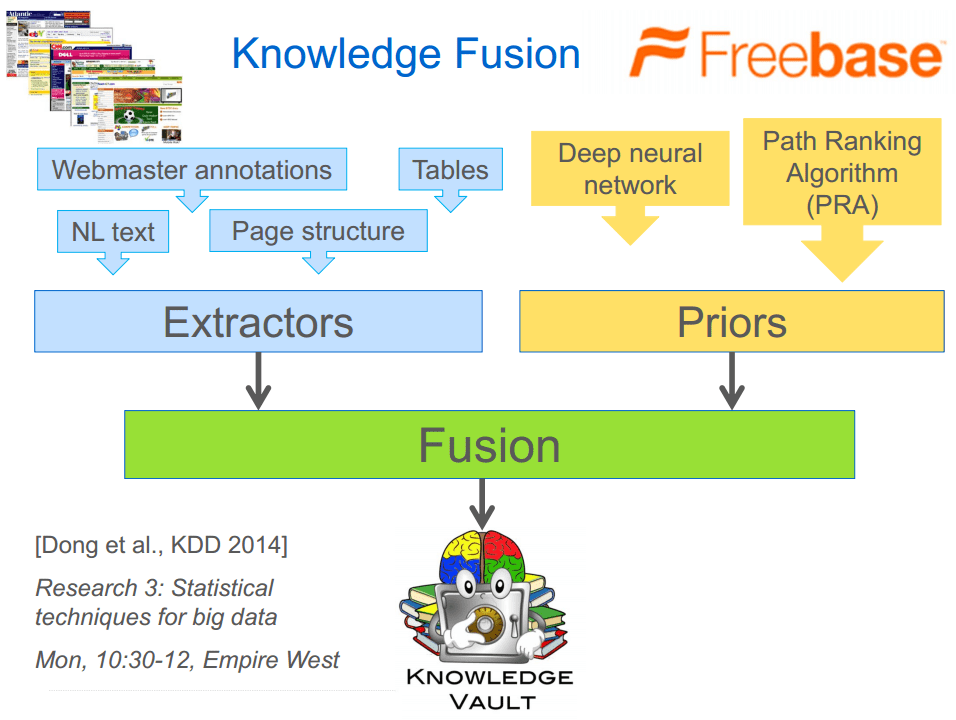 Crowdsourcing to build the Knowledge Vault
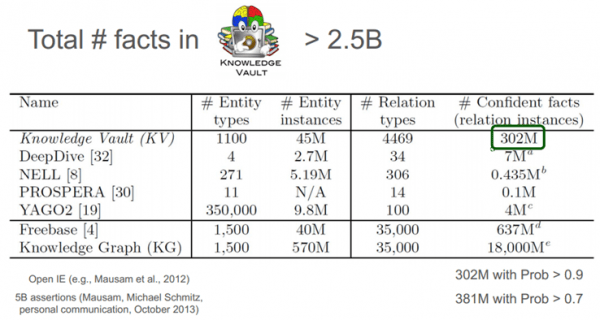 Comparison of knowledge repositories
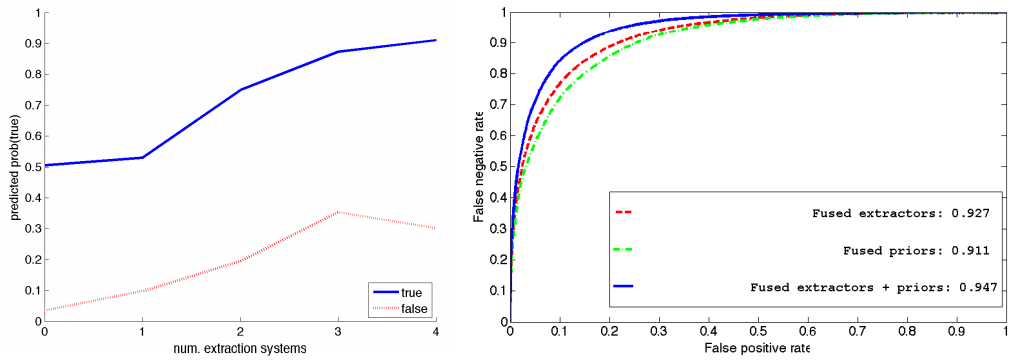
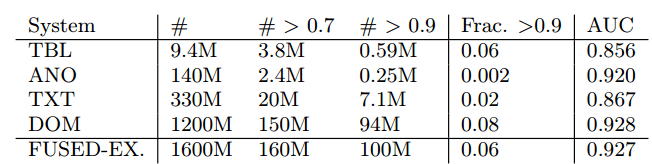 Extraction systems used in the Knowledge Vault
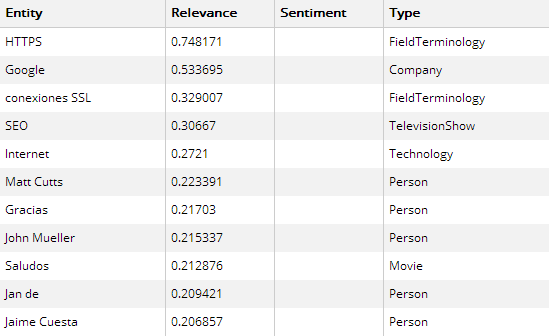 Entities in the article “SEO, HTTPS and Misinformation”
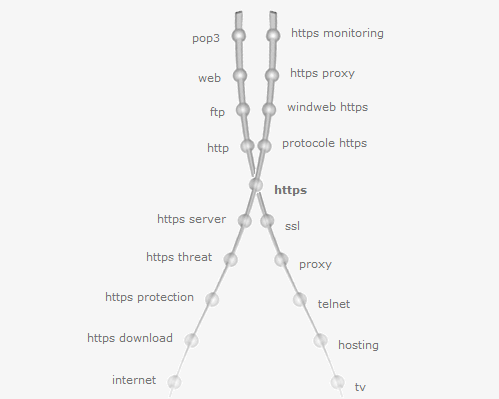 Keyword Map for “HTTPS”
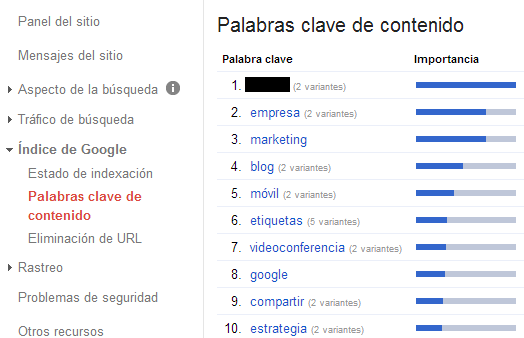 Entities in Google Webmaster Tools