What Is Keyword Cannibalization in SEO and How to Fix It (With Examples)
In this article I present a framework for solving keyword cannibalization in SEO. We'll see how to prevent and fix it when several URLs compete for the same query, which lowers the visibility of all of them. All explained with real examples. At the end, I share a video and a script so you can easily monitor these issues.
What is cannibalization
Cannibalization happens when 2 or more URLs compete for the same keyword.
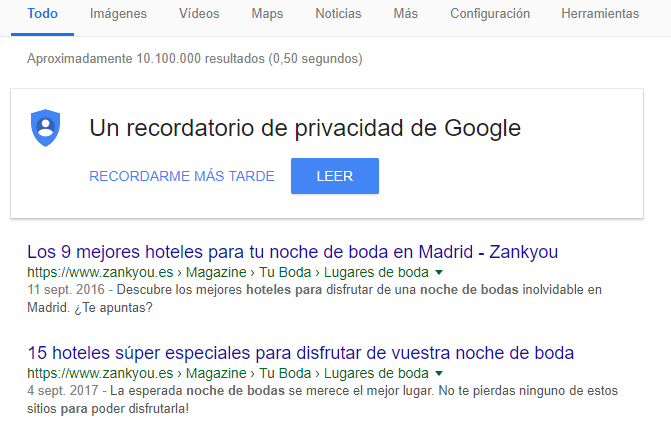
Cannibalization isn't always harmful if the URLs are in the top 10 (the higher, the better). For example, if we search for “hoteles para noche de bodas” (wedding night hotels) from Madrid, we have 2 results from Zankyou (a wedding website) ranking 1st and 2nd:
Thanks to this, we take up more space on Google's SERP, which increases the chances of our result getting clicked:
On the other hand, cannibalization is bad when we're on page 2. It's a sign that the cannibalized URLs aren't relevant and Google is struggling to decide which one to rank, so they end up stealing rankings from each other.
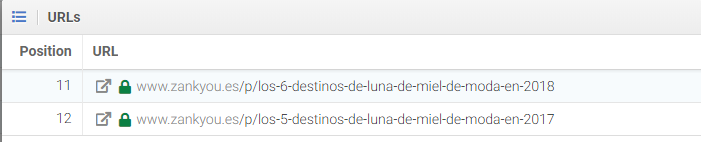
If we search for “destinos luna de miel” (honeymoon destinations), we have 2 articles ranking 11th and 12th:
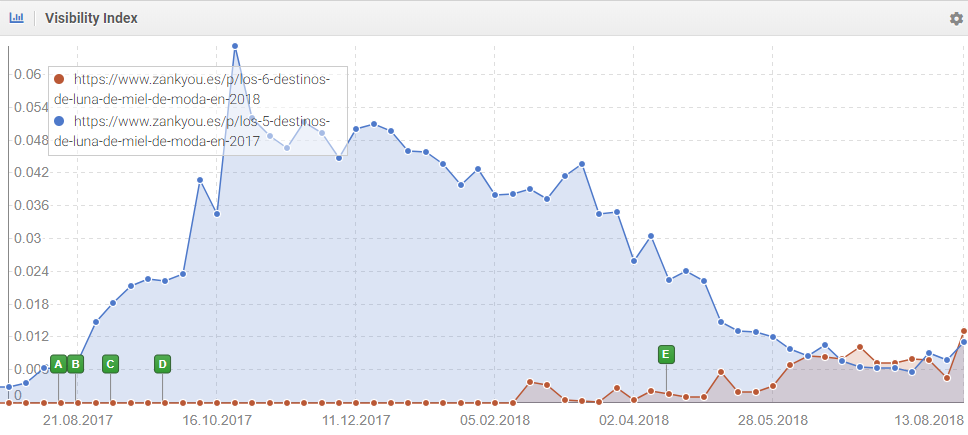
If we look at visibility, we can see that from the day the second article is published, it starts taking importance away from the first one. You can also see that, even in 2018, the 2017 article gets more visibility than the 2018 one on two occasions, which makes no sense:
In SEO, adding up visibility doesn't give you double the visibility (1 + 1 ≠ 2)
You can also clearly see that when the 2nd article is published (on February 7, 2018), we start dropping for that keyword until we disappear from Google's first page:
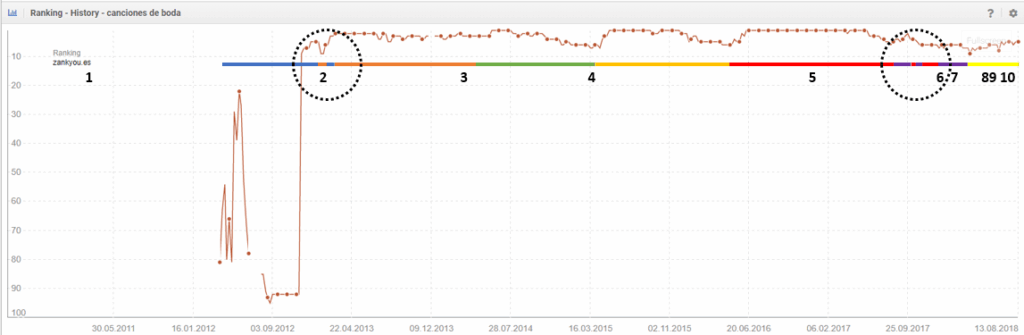
The same thing happens with the keyword “canciones de boda” (wedding songs): we have several articles fighting for the same query:
Looking at the timeline, you can see how at times these articles kept taking rankings away from each other, and the cannibalization specifically happened at the 2 points shown in the next image:
We've ranked first as many as 3 times (with posts 3, 4 and 5), and with each new post we lost the positions we'd gained, until some time had passed. On top of that, the more the posts were updated (far right of the chart), the bigger the impact on rankings and cannibalization. And articles 6, 9 and 10 never managed to rank on Google at all.
If we take the 4 articles that are getting traffic today, we can see them stealing visibility from each other: when one shows up, the other one sinks (visibility takes into account all the keywords an article ranks for, not just one):
They also cannibalize each other for other keywords with similar intent.
“A” is the number of URLs ranking for that query
This happens because new articles get linked from higher up in the site architecture, while old ones get lost in pagination. That's why important articles should always be linked from strategic places, and why it's important to keep an inventory of your articles so you don't step on your own toes when writing a new one.
As you can see, cannibalization is something you need to keep an eye on, and in the long run it can do a lot of damage, as is happening here. So from now on, we're going to prevent it from happening.
How to prevent cannibalization before it happens
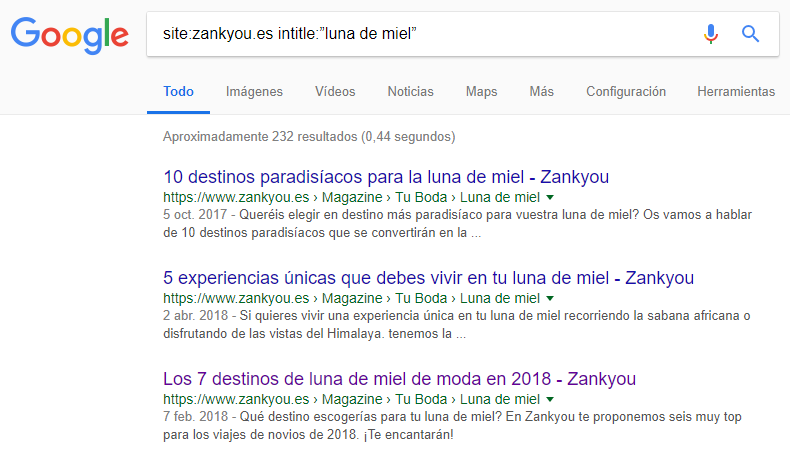
Before writing an article on a topic, we need to check whether similar articles already exist. One of the easiest ways to do this is to search Google for existing articles on our domain like this:
site:<domain> intitle:<keyword>
232 results for site:zankyou.es intitle:"luna de miel" (“luna de miel” means honeymoon)
The “intitle:” operator looks for that text string in the page title, and “site:” limits the search to a specific domain. We can also narrow it down to a path, to search inside a directory like “/p/” (to filter for articles only and leave out the vendor pages under “/f/”):
site:<domain>/<path> intitle:<keyword>
208 results for site:zankyou.es/p/ intitle:"luna de miel"
We can also add more “intitle:” operators to make the search more specific:
265 results for site:zankyou.es/p/ intitle:"luna de miel" -intitle:"destinos"
If these searches return results for that intent, then we shouldn't write a new article. When we run the example search, it turns out we already have 31 articles on zankyou.es:
So we'll try to improve the ones we already have, and look into whether we can write new articles or retarget the existing ones for other intents.
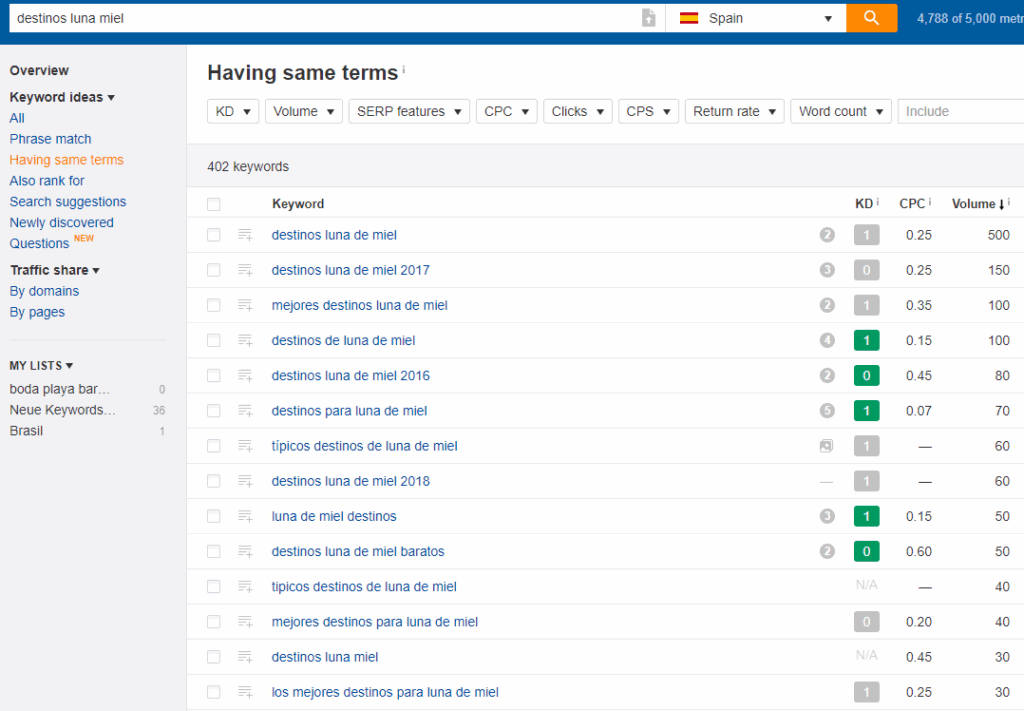
To discover search intents we'll use Ahrefs, Sistrix or Semrush. With these tools we can see that for “destinos luna miel” (honeymoon destinations) people search for:
With a date (recurring content): 2017, 2018...
Type: best, paradise/exotic, with kids/a baby, pregnant...
Price: cheap or budget...
Location: Europe, South America, the Caribbean, Mexico, Colombia...
Season: summer, October, Christmas...
From this, we could come up with the following articles to cover different intents:
Best paradise and exotic honeymoon destinations
Best Honeymoon Destinations 2018
Budget honeymoon destinations: travel cheap!
Honeymoon in Mexico: discover its best beaches
Destinations to take the kids on your honeymoon
Pregnant on your honeymoon? Easy destinations to visit
Spring honeymoon destinations
…
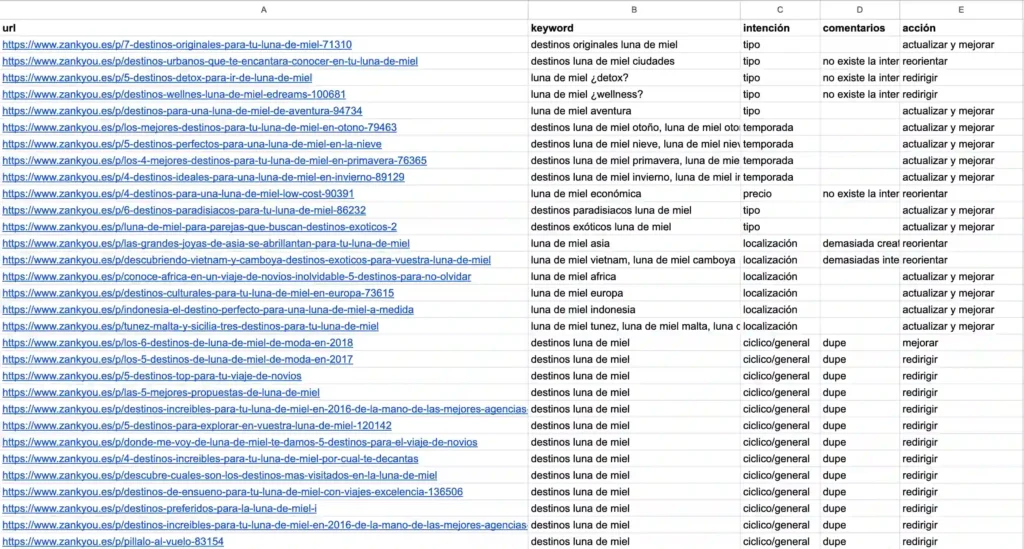
As you can see, in the list of 31 articles there are several that already try to satisfy the same intent. In that case we have to keep just one: the one that ranks best for that intent and/or gets the most traffic. If we're on the first page, there's no need to merge them, but if we're not right at the top, maybe we should update and improve them (and republish them).
Here's a possible worksheet for the 31 articles above:
To avoid duplicates (which, as we saw earlier, were also cannibalizing each other), just don't write a new article every year: keep the URL, update the article and improve it if needed, republish it and change only the date in the title.
Wedding dresses and collections are a different story, because some people search for previous collections. So in that case it does make sense to keep the old articles, and that way we'd capture the traffic the brands themselves can't get. All we'd need to do is make it easy for users to see the articles about other years' collections.
To sum up, we can see how an article we were going to write turned out not to be needed after all, and we had more work and more room for improvement than it seemed 🙂
How to fix existing cannibalization
Now, what about the articles we already have that are cannibalized, which we found by running a cannibalization analysis? (At the end of the article I share a tutorial on how to find cannibalization issues with Python.)
If we have 2 articles getting traffic and one of them is competing for a query we didn't plan it for, the ideal thing is to “de-optimize” that article for that query, focusing it more on the keyword we originally wanted it to rank for.
At this point, it's worth taking the chance to review the other article too, and improve it for the cannibalized query if possible.
We can see that these two URLs are the ones showing up for “anillos de compromiso con zafiro” (sapphire engagement rings), and the two articles are completely different. It would be enough to change the title and H1 of the first one to “Anillos de compromiso con zafiro” to better target that keyword, update the article if the content is outdated, and republish it. At this point it would also be good to check whether we have more articles about the same thing (using the method above), so we can redirect them to these ones and try to add their content to them if it makes sense.
A different case: if all the articles are actually fighting for the same thing, then we'd pick the best one (ranking/traffic), improve it if needed and republish it. For example:
In this case both articles are about making table arrangements and centerpieces (the keyword means “simple wedding table arrangements”), and the first one is about making them with jars, which nobody searches for. The second one is more general, so we could move the content of the first one into the second to enrich it, as another way of making arrangements. We'd look at improving the second one if needed, redirect the first one to the second and republish.
At this point it would also be good to check whether we have more articles about the same thing, so we can redirect them to these ones and try to add their content to them if it's not already there. That way we improve the article with information we already have, and the redirect will work much better.
In general, it's better to redirect than to noindex, to keep any external links. Also, if you decide to remove an article by setting it to “hidden” in the CMS (which adds a noindex and removes the article from the sitemap), you should also remove the internal links pointing to it.
How to find cannibalization issues with Search Console and Python
In this video, Hamlet Batista, founder and CEO of RankSense, interviews me. We talk about how I started using Python for SEO, even though at first I didn't like programming. I share how it helped me automate repetitive tasks and solve complex SEO problems. I explain step by step how to detect these cannibalization cases with Python, pulling data from Google Search Console, analyzing it, and applying fixes like consolidating content or adjusting the site architecture to improve SEO performance.
In this article, Christian Oliveira and I summarize the talk we gave at Congreso Web, a Spanish web conference (get the slides here). In it, we set out to explain this technology (PWA) and how SEOs and developers need to deal with it to make it accessible to search engines. It's based on our experience […]
I’m writing this post because I’m tired of reading more and more nonsense about SEO and HTTPS (Hypertext Transfer Protocol Secure) after Google’s announcement on its blog, “HTTPS as a ranking signal”. But it didn’t all start there. The buzz began picking up steam in the SEO world in March 2014, when Matt Cutts said […]