Every time a new concept or acronym pops up in the digital marketing world (GEO, AEO, LLMO, GAIO, LSO, LEO, etc.), the debate is whether we're looking at a real revolution or the same old strategy under a new name. In my experience, optimizing for large language models (LLMs) is, at its core, the logical evolution of good old SEO.
In this post I go over how we adapt SEO techniques so that engines like ChatGPT (or any LLM) take us into account in their answers. And in the end, the key is still the same: well-structured, readable and trustworthy content.
1. The growth of AI traffic and why it converts better
Traffic from LLMs converts better. Here's some data that shows why it's worth keeping an eye on:
- Kevin Indig analyzed more than 7 million sessions (from ChatGPT, Copilot, Gemini, Perplexity, etc.) and compared them with Google Search. He concluded that the average time on page for a click coming from a chatbot is 10.4 minutes, versus 8.1 minutes for Google. People also view more pages per session and are more likely to buy something or hire a service.
- Andrea Volpini shared a case on X where AI traffic had a conversion rate of 1.378% versus 0.201% for Google organic traffic. That's a conversion rate almost 7 times higher. Checking with my own clients, I've seen the same thing: it's much better traffic than any other channel.
- Ahrefs: traffic from AI search (ChatGPT, Copilot, Gemini…) makes up only 0.5% of the total, but generated 12.1% of leads in the last 30 days. That means it converts about 23 times better than traditional organic traffic.
- Vercel: about 10% of their new signups come from ChatGPT, up from 4.8% the previous month and 1% six months ago, which shows a strong upward trend in conversions from AI traffic.
In other words, it's not just that the use of chatbots or “LLMs with a search interface” is growing; the few clicks they send also seem to be highly "qualified" to convert. There's no mystery here: these visitors arrive better prepared, because they've already gone through a deeper exploration process in their conversation with the LLM. Add to that the fact that these are longer, more complex queries, so they're more "narrowed down."
Which makes you think: “Am I getting my website ready to show up in AI answers?”
2. How to show up in “AI Overviews” and LLM chatbots
First of all, we need to distinguish between two scenarios in which an LLM can show your content:
-
Answer “from the model's memory”: In this case, the LLM was previously trained on a huge amount of text (possibly including some of your content, or other people's content talking about you), and when it generates an answer, it does so “from memory,” based on patterns, without going to external sources at that moment. This scenario is like when someone studies a book and, some time later, explains a concept to you without needing to look anything up. The model combines what it learned, but it doesn't necessarily cite the original source. One thing, though: the big LLMs are trained on "snapshots" of the web, so if your company is new, you won't show up until the next cycle (as long as you've done Digital PR on authoritative sites).
-
Answer in the “inference phase”: Here, the LLM doesn't limit itself to its internal knowledge. In the inference phase (the moment the chatbot generates the answer), the model searches external sources to complement or update the information. This is usually done with techniques like RAG, where the system queries databases or web pages and then integrates those snippets into the final answer. It's in this second mode that you have a better chance of being cited directly (or linked), because the model “reads” the current content of your website and explicitly includes it in the answer, instead of relying only on its previous training.
2.1 What is GEO and how is it different from SEO?
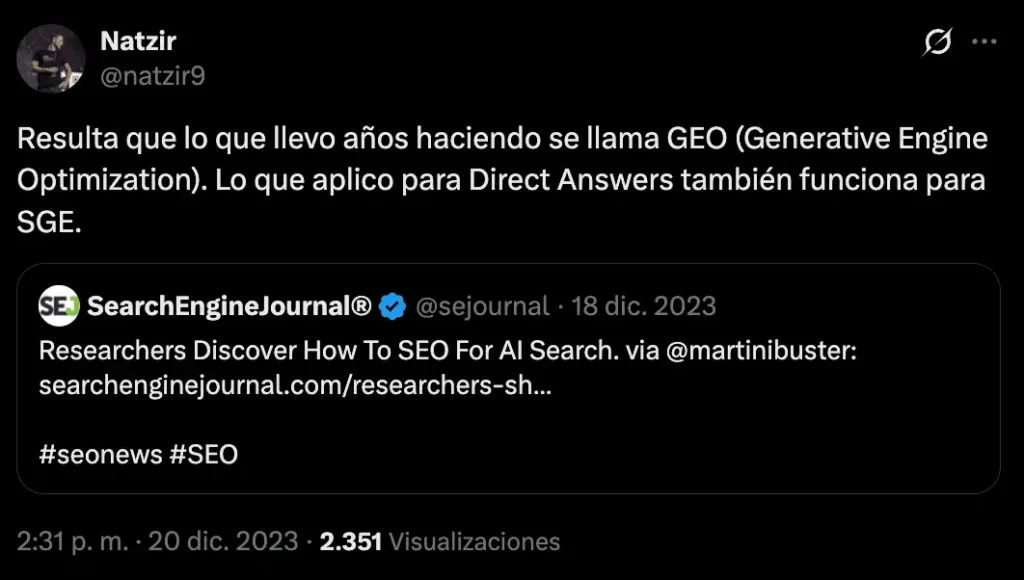
Spoiler: it isn't. GEO, short for Generative Engine Optimization, is a term for how to optimize content for search engines powered by generative AI, originally aimed at Google SGE / AIO or Bing Chat. The concept was coined in the paper GEO: Generative Engine Optimization by Pranjal Aggarwal, Vishvak Murahari, Tanmay Rajpurohit, Ashwin Kalyan, Karthik Narasimhan, and Ameet Deshpande (2023).
This was my response to that:
2.1.1 "GEO" in practice
The main techniques the paper proposes for GEO include:
- Cite sources: Adding clear citations and references to reliable sources increases credibility and, therefore, visibility in the generated answers.
- Quotation addition: Including relevant direct quotes strengthens the content's impact, which translates into more “weight” in the answers.
- Statistics addition: Using quantitative data makes the content more authoritative.
- Fluency and clarity optimization: Improving the readability and coherence of the text is essential for LLMs to interpret the information correctly.
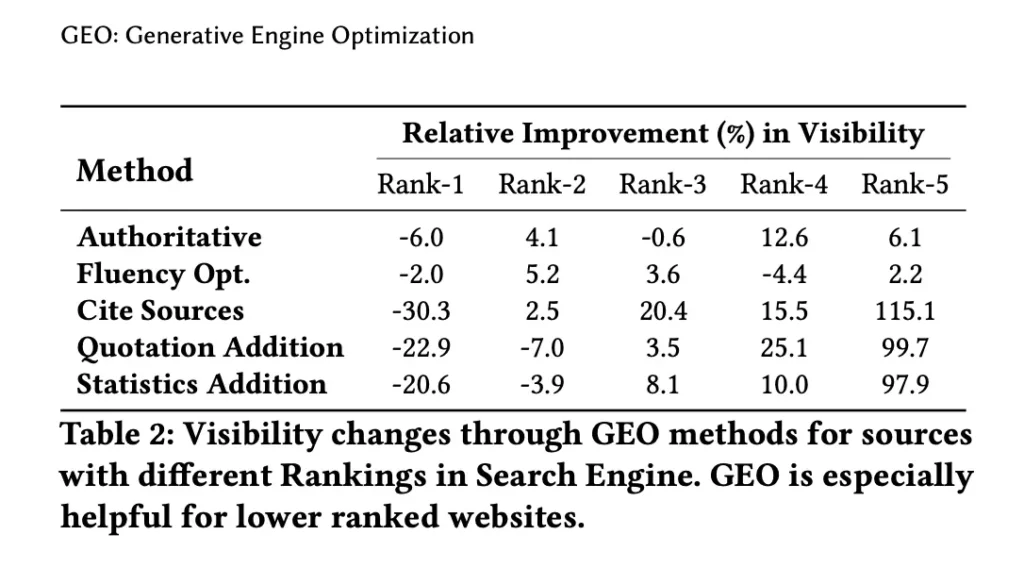
GEO (Generative Engine Optimization) techniques
This lines up pretty well with what I used to do for featured snippets. What I've been doing for years is trying to mimic, at a very basic level, how search engines work internally:
- Candidate selection phase (initial ranking): I use cosine similarity, BM25, TF-IDF or Token Set Ratio between the top-performing query and the meta title and H1 to detect which landing pages have the most room for improvement, and I optimize the meta tags to get a better score.
- Rerank phase: I create several versions of the text until I find the one that returns the best relevance score for N queries of that landing page, using a distilled version of BERT trained for Q&A. In these versions I use the techniques mentioned in the paper above, which were already known for their influence on direct answers.
Basically, if you already optimize a text so Google shows it in featured snippets, you're very close to what's done for SGE / AIO. For years, the first page of search results has already been ranked by machine learning algorithms (I explain why in my post on what a hybrid search engine is), and some people still don't seem to have noticed.
“If you're optimizing for search, then you're kind of also optimizing for AI Overviews and AI Mode,” referring to grounding – John Mueller, Google (2025).
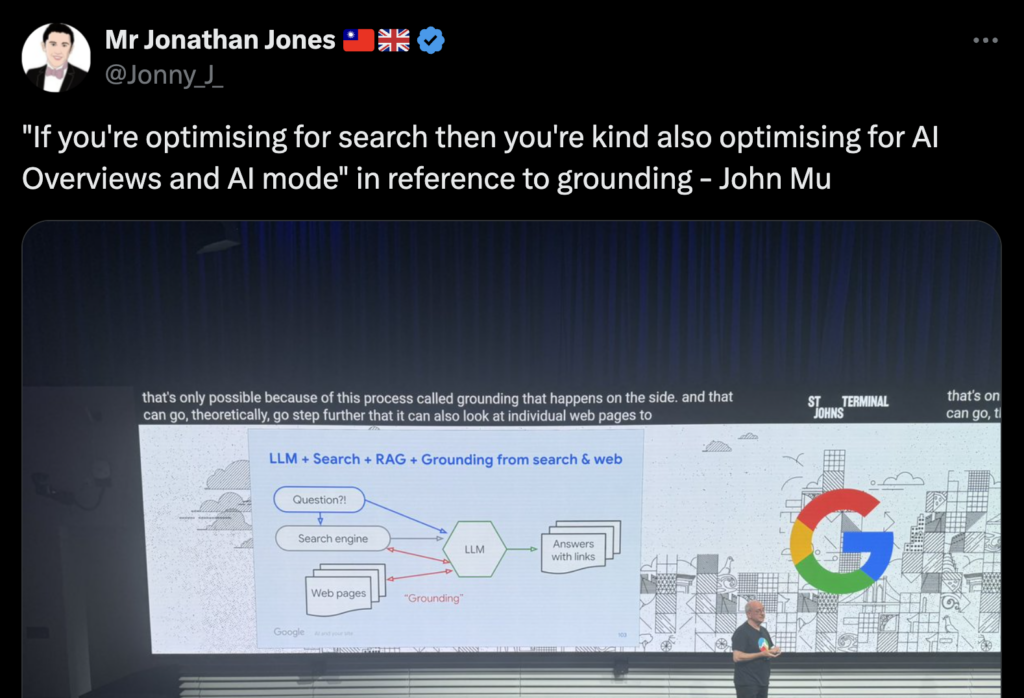
The difference is that an LLM in the inference phase doesn't just extract a snippet; it “merges” and “reorders” information from several sources to give the best answer. Remember that AI models don't work like Google Search. They don't crawl the web in real time; they're trained on existing corpora and then, during inference, they can use RAG (Retrieval-Augmented Generation) to add up-to-date data.
2.2 Key factors for LLM visibility in the inference phase
To back up the idea that “it's nothing new, it's just SEO,” you'll want to see what the folks at Jina AI are doing with their DeepSearch.
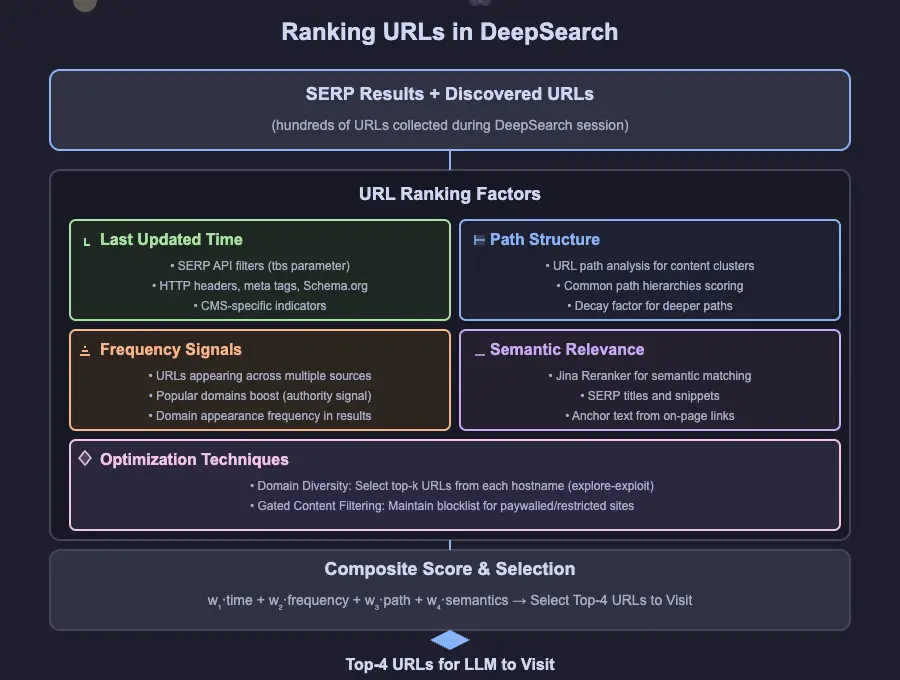
Snippet selection and url ranking in deepsearch deepresearch
They've shared how they select snippets and prioritize URLs to show in their search engine. Even if it feels advanced or different, the factors and techniques used by Jina, ChatGPT, AI Mode, Perplexity, Claude... really aren't that different from a traditional search engine, as we'll see below.
2.2.1 SEO for AI
- Freshness: last-updated date (via HTTP headers, visible dates or Schema.org). In this case, Jina AI uses Schema.org only to check the date. Although we know that structured data like Schema.org doesn't affect LLM training (LLMs are trained on plain text), it could help with “grounding” or RAG integration, as in this example (as long as it isn't stripped out, which is what happens with the other AIs). Basically, the clearer your data structure, the easier it is for the AI to understand you and cite you reliably. Also, I think that in a future of agentic traffic, this will matter even more, and so will structured content via feeds. Another thing we can do here is make sure changes to our content get picked up right away (sitemaps.xml, IndexNow...) and, for content that needs "freshness", keep it up to date as we always have. That said, content freshness plays an essential role, but it works differently depending on the model. Recent research shows that LLMs used to rerank results (GPT-4o, GPT-4, LLaMA-3, Qwen-2.5) favor content with more recent dates. Here's the interesting part: these models don't really "understand" time. When fake dates were added to the same texts, the top 10 shifted by up to 4.78 years toward "newer" content, and between two equally relevant passages, the preference flipped in up to 25% of cases. Models read dates as text, not as verifiable facts.
- Frequency and domain authority: Whether multiple sources reference that content and whether those domains are relevant. When we do link building, don't we try to get links from the sites that already rank for specific searches? For AI, what we do is try to show up in the references LLMs cite. If we can't be the primary source, we should at least be on the sites these AIs consult, which tend to be the ones ranking at the top of search engines. There's also a new factor that could directly influence visibility in language models: deals with content providers. OpenAI has signed partnerships with media outlets such as Financial Times, Le Monde, The Atlantic, Axel Springer (owner of Politico, Business Insider...), The Guardian, PRISA Media (owner of Spain's El País, AS, Cinco Días...), News Corporation (The Wall Street Journal, The Times...), among others. This means content from these outlets is more likely to show up in ChatGPT answers, whether through direct quotes, summaries or links. Digital PR! Also, a recent analysis of more than 1,000 queries confirms that AI models have a clear preference for "earned" sources (reviews, press articles, comparison sites) over brand content or social media. The interesting part is that each AI shows different citation biases: Claude tends to reuse the same domains regardless of language, while GPT-4o varies its sources significantly depending on the language or country of the query. This reinforces the importance of a diversified Digital PR strategy adapted to different markets.
- Path structure: Semantically organized URLs.
- Semantic relevance: These systems use embeddings and reranking models to determine relevance. Isn't that similar to the process I just explained above? Here I'd include:
- Clear, direct and unambiguous language: Make it easy for the AI to understand exactly what you want to say. Avoid excessive jargon if your audience doesn't need it. And something that has always worked really well is answering the question directly at the start of a section, not in the middle or at the end. Example: What is a cut-off low (DANA)? A cut-off low (known in Spain as a DANA) is a weather phenomenon that happens when a mass of cold air breaks away from the general atmospheric circulation, causing heavy rain and storms, especially along Spain's Mediterranean coast. [Detailed explanation follows...]. This kind of format, which works really well for featured snippets, has also proven useful in RAG. It's not a trick, it's math.
- Entity richness: It's very common for LLMs to use a Knowledge Graph in their RAG pipelines (GraphRAG), so using related entities helps the AI connect your content to its knowledge base (Knowledge Graph). Entities can also be especially useful for the process explained in the next point.
- Lists, bullet points and tables: These are semantic formats the AI can easily digest, and they can be used directly in summaries or answers.
- Factual, verifiable information: Use quantitative data, statistics and clear statements. Search engines in general tend to prefer clear statements, as long as they're part of the consensus.
- Relevant anchoring: In Jina's documentation we can see that they might be using the anchor text of internal links.
- Late Chunking: Jina uses a RAG technique to select relevant chunks from long documents without losing context. If you're an SEO, you've surely heard of Google's phrase-based indexing. I'm not saying they're the same; it's just a conceptual parallel with good old SEO, because both try to improve the relevance of the retrieved content. Phrase-based indexing does it with phrases that help rank documents, and RAG does it by finding relevant chunks for the LLM to use as context. My advice here:
- Structure your content in self-contained paragraphs that can be understood without additional context. In other words, comprehensive coverage (in well-defined chunks) helps these systems. For example, by addressing related questions and subtopics within your articles. This is especially relevant for covering the "Query Fan-Out". Example: An article about "Black Holes" could have sections on "What are they?", "How do they form?", "Types", "Images", "How are they detected?", etc.
- Using clear, hierarchical headings (H1, H2, H3) would help the AI understand the structure and the relative importance of each section. Hx headings aren't just important for SEO; semantic HTML and accessibility also matter for web agents and assistants.
- Each AI uses chunks of different sizes and with different overlaps, and we don't know what those sizes are, so don't obsess over this: you won't get anything useful out of it, and it can do you more harm than good.
- Content accessibility: If your content is behind a paywall, tough luck: the AI won't be able to access it (or it would be violating the ToS). Once again, nothing new, because bots don't index what they can't access. Also keep in mind that many chatbots still don't render JS.
All of this is still SEO (I challenge you to name one thing that's actually new), and the semantic SEO work should have been happening since 2013. Some of us have been shouting it from the rooftops since then, but few people listened. Hummingbird (2013), implied links and brand mentions (2014, a patent related to Panda), RankBrain (2015), phrase-based indexing (a 2009 patent, updated in 2018), Information Gain (2018), BERT (2019), MUM (2021), HCU (2022)... I'll say it again: the process I explained earlier, which already worked for featured snippets (2014), still works for AI Overviews. Now lots of people are jumping on the bandwagon, but from what I'm seeing, it's being done pretty poorly and with a misunderstanding of the fundamentals. What's clear is that the return on this work has kept growing, and the new reality of generative AI has only reinforced these practices, for the reasons we'll see next.
2.2.2 How an LLM “understands”: monosemanticity and disambiguation
AI models work with what's called monosemanticity. There are “neurons” that fire when the model detects a very specific concept, for example, “email address” or “city names.” A recent Anthropic study explains the idea, and once again it resembles the old semantic SEO concept of “entities” and “disambiguation”.
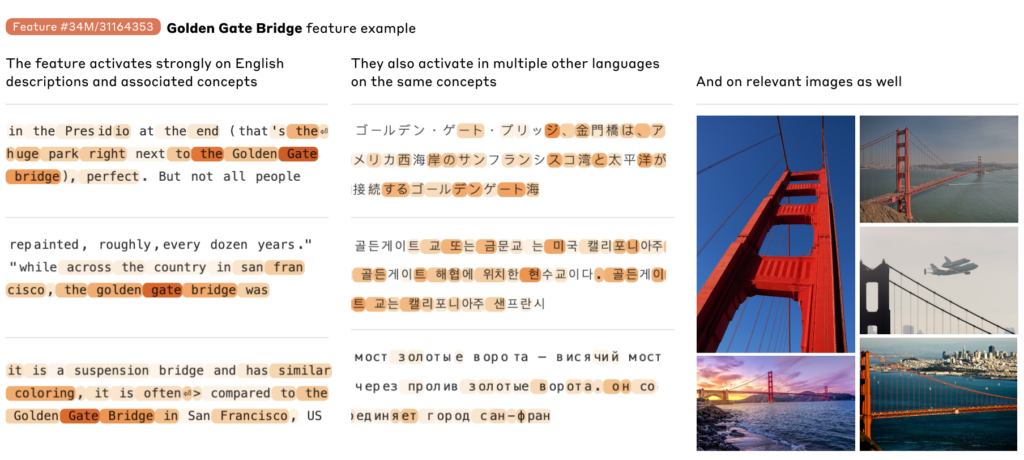
Monosemanticity
Models also store “facts” in their internal layers. Classic example: Michael Jordan → Basketball. That association gets stored in the network, specifically in the multi-layer perceptrons (MLPs).
Even though there are specific neurons, it's not that simple: sometimes several concepts get mixed together in “superposition.” That's why interpreting an LLM is complex, but it gives us a clue about how to optimize: make your content as “unambiguous” as possible for the model.
In short, if we want LLMs to take us into account in their corpus, that is, to understand who we are and what we do, what we need to do is explain our content better, without ambiguity. Just like we do for any other search engine by working on semantics.
2.3 AI search engines have a citation problem, and why you should care as an SEO
As we know, generative AI models, including OpenAI's new GPT-4.5, often suffer from the well-known phenomenon of "hallucinations," generating answers that may sound very convincing but are wrong or completely made up. For example, GPT-4.5 still hallucinates on more than 1 in 3 questions. That said, it's a big improvement over previous versions. To put it in context compared to GPT-4o:
- It hallucinates less: GPT-4.5 only "makes up" answers in 37.1% of cases on SimpleQA, compared to 61.8% for GPT-4o.
- It knows more: GPT-4.5 gets 62.5% of SimpleQA questions right, a huge jump from GPT-4o's 38.2%.
But when it comes to citations, things are much more worrying.
A recent study by the Tow Center for Digital Journalism confirmed that this isn't just an OpenAI problem; it's widespread across generative search engines. After evaluating 8 AI search engines (including ChatGPT, Gemini, Perplexity, Grok and Copilot), they concluded that all of them had serious trouble citing sources correctly, with very worrying rates of wrong answers or made-up links. Some numbers:
- More than 60% of the answers were wrong.
- Premium versions got it wrong more often, and more confidently, than the free ones.
- Chatbots like Gemini and Grok 3 make up URLs, so there's no way to verify the sources. Gemini, yes, the same one Google now also uses for AI Mode…
- Many of them ignore robots.txt and access content that publishers have blocked.
Another curious thing: licensing deals with publishers don't guarantee accurate citations or full respect for crawling restrictions either.
And it doesn't end there. Another independent study by the BBC matches what we've just shown. More than 50% of the answers from assistants like Gemini, Perplexity, ChatGPT or Copilot contained significant errors, including distorted quotes, wrong data and broken links. The most alarming part is that when they mention trusted brands like the BBC, users tend to trust the answer more, even if it's false. One more reason to take this problem very seriously.
You've probably seen in your analytics that a lot of the traffic these bots send lands on a 404 page. If you haven't, I encourage you to check. What should you do in these cases?
Google is already warning that this could increase in the coming months. So what should you do with those hallucinated links that cause 404 errors? Mueller recommends having a good custom error page that explains what happened. He even suggests using that URL as an internal search query to try to point users to what they were looking for.
But more creative solutions are also being suggested, such as adding a message on the 404 page itself aimed specifically at people arriving from an AI-generated link, explaining that the link is a hallucination and that the site has been updated to warn about it.
Redirect these links? Not a bad option. If there are a lot of them, it may not be worth it, although I can think of ways to do it automatically using semantic similarity. But if you're a small brand, every click counts.
Even so, this is going to be a headache, so you'd better start properly monitoring those ghost URLs, their impact and how to fix them. Then again, nothing new if you're an SEO 🙂
3. In short: SEO for AI is still traditional SEO
The technical evidence shows a massive overlap in the crawling, indexing and serving phases across Search, AI Mode / AI Overviews and Gemini. In other words, Google's AI features use the same crawlers and benefit from the same indexing technologies that already analyze content, like BERT. And when it's time to serve results, these new features are built on the same foundation of hundreds of signals, adding extra layers that rely on, and are grounded in, the existing search index.
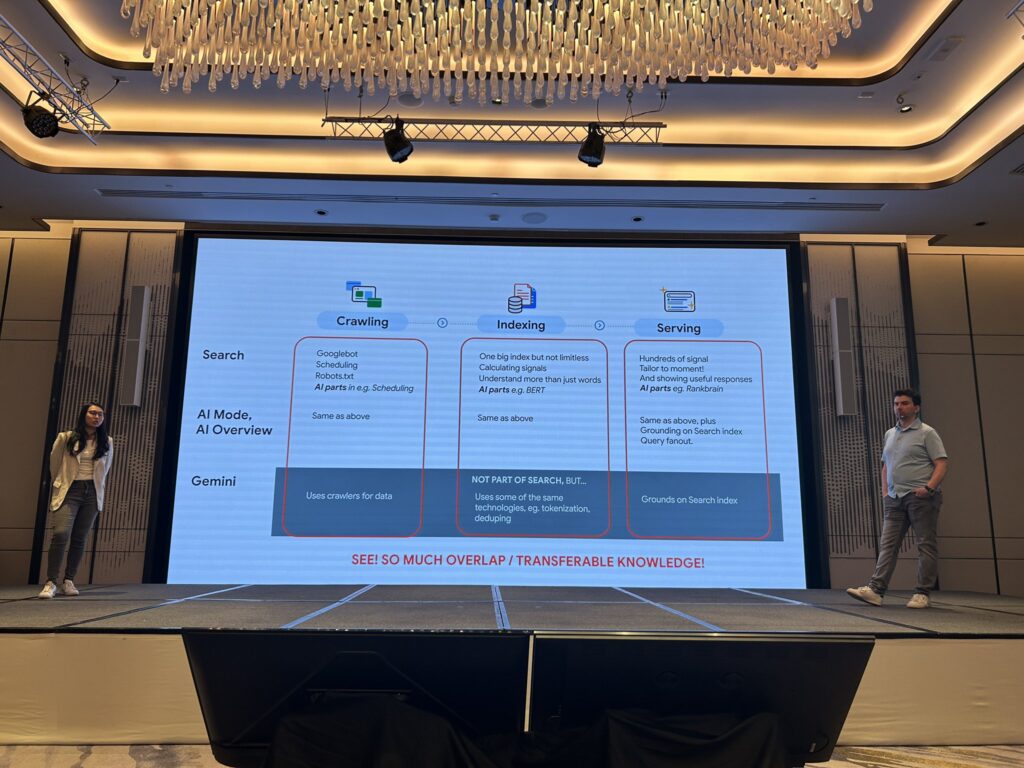
The only things that change in AI Mode / AI Overviews are grounding on the search index (where the same optimization that works for featured snippets applies) and query fan-out (an evolution of query augmentation, which is itself an evolution of query expansion). We didn't have to rename SEO for MFI (mobile-first indexing), or for featured snippets, or for structured data, or for social media, etc.
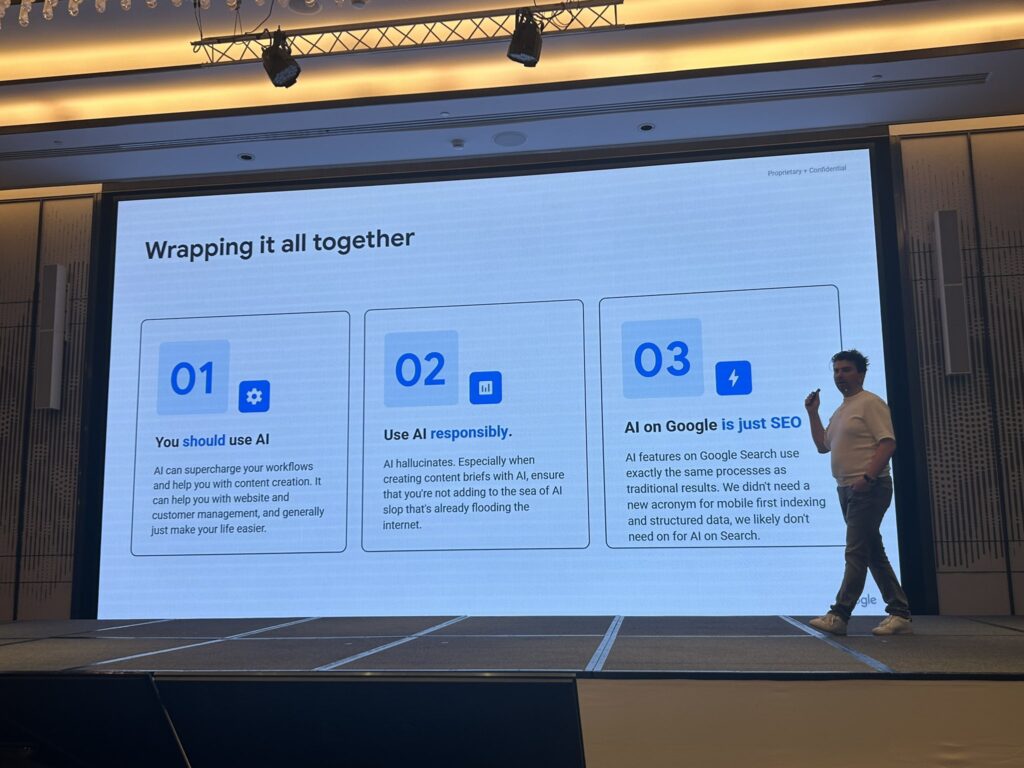
In the end, it turns out we've been doing SEO for AI all along without knowing it. When terms like AEO, LLMO, GEO, GAIO, LSO or LEO pop up, it can seem like everything has changed. But the essentials stay the same: it's still a game of relevance, authority and accessibility. The difference is how the model consumes and interprets that information to return it as an answer, and for us, the way we work doesn't change.
Related:
What the ChatGPT Leaks Teach Us About SEO for AI
Local SEO for ChatGPT
What the ChatGPT Leaks Teach Us About SEO for AI