There's always been a debate about whether investing in Google Ads affects SEO. But when we say it affects SEO, what do we actually mean? Organic traffic, or what the SERP looks like? And if it affects the SERP, is it a ranking factor?
I've already made my opinion clear in plenty of places: Google Ads is not a ranking factor. So I'm writing this article to show, with (current) data, what really happens when we invest in Ads and why some people believe it is a ranking factor.
A site invests in Google Ads…
Here in SEMrush we can see a site that suddenly starts investing more heavily in Ads.

… and organic traffic goes up
In this other chart we can see organic traffic start to rise at exactly the moment the investment goes up (note: this is an Analytics view that only shows Google organic traffic, and the Analytics and Ads accounts are properly linked):

I've seen this many times: you invest in Ads and organic traffic shoots up, you stop running Ads and organic traffic drops. But it doesn't always happen. I've seen it mostly on sites with a good number of high-traffic keywords ranking in the top 5, and usually with more returning traffic than new traffic.
Seeing this, it's no surprise that people claim Ads is a ranking factor in Google. But then rankings should go up too, right? Well, no. Rankings stay stable, and so do the number of ranking keywords and the visibility index (both our own and Sistrix's).
Rankings don't change with Ads, but organic CTR does
Google Ads is just another channel, like TV, email… If you run a campaign, branded traffic from first and second visits goes up, and so does CTR on non-branded searches, thanks to brand recognition. Here we can see that returning organic visits grow more than visits from new users (and on top of that you'd have to add the returning users we miss because of lost cookies):

Here we can see the organic increase, mainly in the mobile + returning segment:

Oddly enough, this site prioritizes desktop in its Ads spend because mobile converts poorly. But here the CTR of mobile ads is roughly 150% higher than that of desktop ads (on the landing pages that went up in non-brand organic). And in SEO, mobile visibility is slightly higher than desktop visibility.
As for organic transactions, they went up 27.95% because of the Ads campaign, which means these aren't new users acquired through SEO.
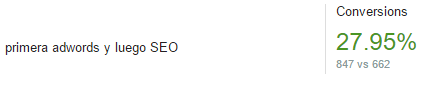
To get this report, here's what you do:
- Go to the Multi-Channel Funnels conversion paths and set the before and after periods in the date range.
- Adjust the lookback window to the period you chose.
- Pick the conversion you want to look at, in my case transactions.
- Create a new conversion segment where you set Ads as the first interaction and then SEO as any interaction.
- Apply the segment and take note of the increase or decrease in conversions.
As for organic CTR, which we've seen can change if you run Ads, there's a report where you can see it, as Enrique del Valle rightly points out in the comments. On the other hand, organic traffic could also grow for the reason I'll explain in the next section.
"Personalized" rankings COULD change if you run Ads
Google uses the user's past behavior to re-rank results based on lots of data. Re-ranking means reordering an already established set of results to fit the user. The data used for re-ranking can include user metrics, the profile of the user and of similar users, search entity associations, the person's location, the device used (speed matters more on mobile) or even, as we'll see below, the user's behavior on Ads. The ranking is unique to each user, and any rank tracking tool gives us NON-personalized data. That's why we won't see the rankings change, but we will see the traffic change (returning traffic, as we saw in the previous example).
Personalized results are nothing new. Back in 2005, Google was already showing results based on the user's search history. In 2007 it showed personalized results to logged-in users even without search history turned on, and by 2009 you didn't even need to be logged in. On top of that, ever since it launched Ads, Google has known which ads you click (you can see it here, unless you've turned it off like I have), and as long as you browse with Chrome (a browser with a 60% market share in Spain), it doesn't matter whether you're on mobile or desktop: Google knows exactly who you are.
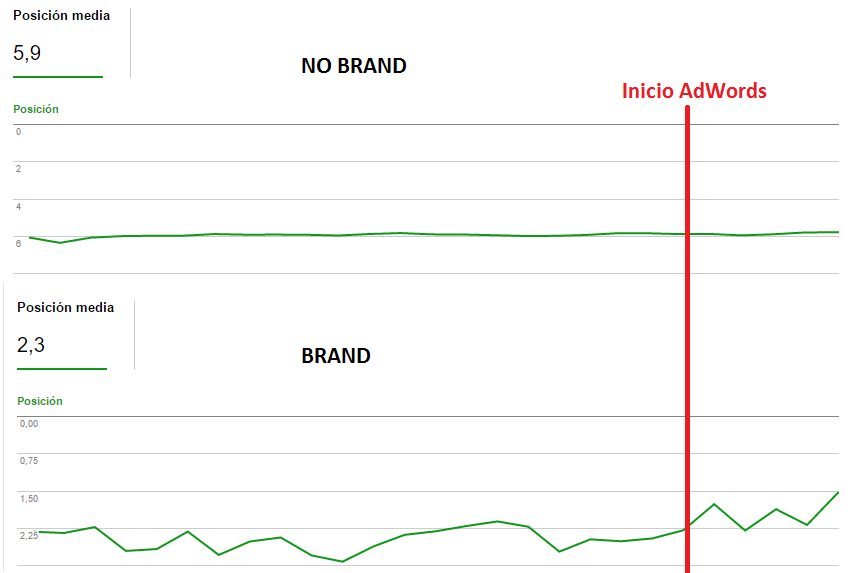
As Iñaki Huerta says in the comments on the post, in Search Console you could see the effect as an increase in average position for personalized results, since this metric reflects the position users actually saw when they came to the site. The day I wrote the post I didn't see anything unusual (SC data has a 2-day delay), but I just checked again, splitting the average position between branded and non-branded keywords, and… ta-da!! There's practically no change in the AVG Position of non-brand keywords (if it stays like this for longer, it looks like a new floor could settle 3.3% above the current one for non-brand), but we do see a notable increase in the AVG Position of brand keywords:
Patents that link Google Ads with SEO
This Google patent (which I found thanks to Bill Slawski's blog) was filed in 2003 and granted in 2014. It explains that behavioral data on how users interact with ads can be used to understand user intent and needs and, with that, show organic results that better match the user's behavior on Ads (we'd be talking about re-ranking at query time). In other words, at query time Google looks at the documents and ads relevant to that query, and then, based on the Ads data associated with that query, it looks for the best organic options to cover every information need. And that would obviously have a direct effect on personalized rankings.
Nowhere in the patent does it say that Ads is a ranking factor. It only explains that aggregated Ads data (which ads get clicked for each query) could reorder the organic results; my interpretation is that it would be most noticeable in personalized results, for the reasons above. Also, from what they describe, it really looks like it would apply to competitive, high-volume keywords (they'd need a lot of Ads behavior data for it to happen). The patent also says that it's hard for us to manipulate Ads behavior data, and that this is exactly why it would be a good signal for improving personalized organic results. The rest of the patent mentions applications that I haven't seen implemented to this day.
Earlier I mentioned that Google also re-ranks based on search entities. Well, according to this other Google patent (filed in 2009 and granted in 2013), the relationship between ads, the document and the query is another kind of search entity that Google uses to calculate the "probability value" between a query and the result shown in a personalized SERP.
Patents are always tricky because they're open to interpretation and, even when they're granted, they may not be in use. I studied these particular patents 2 or 3 years ago when Bill wrote about them, but I've been seeing this behavior for longer than that, so I don't see why they wouldn't be using them, given that they've been working on Ads and SEO synergies since 2003.
I loved this talk Gianluca Fiorelli gave at SEonthebeach (an SEO conference held on a beach in Spain), where he explained something I couldn't agree with more. He said that if you study the authors behind the patents and which parts of the algorithm they're working on or have worked on, you can see how important that document might be to how Google works. If you look at the names behind the patents I mention here, what they work on and what they've published, you'll see they're worth taking seriously.
Update: here's the talk I gave at eShow Madrid (an e-commerce and digital marketing trade show), where I present this case and mention more patents and other synergies between channels:
Conclusion
Just as we SEOs need to know the difference between direct and indirect effects, we also need to know the difference between Ranking (general) and Re-ranking (per user).
Google Ads is not a ranking factor. You'll only see a change in organic traffic for specific user profiles, on sites and keywords that meet special conditions like the case I've shown here, and only if the Google Ads campaign does a good job of meeting user needs. That doesn't mean you shouldn't run Google Ads for SEO, because when it's done well and combined with SEO, you can build a really interesting snowball of CTR, other user metrics and brand + category associations that, little by little, could end up boosting your (general) rankings. Also keep in mind that any campaign can help you earn links. But Google won't move you up just because you run Ads, or move you down because you stop.
To dig deeper into joint SEO/PPC strategies and their impact, here's Edgar Sánchez's great talk: