When a search engine needs to find information, it can try to understand you in two ways: by interpreting the abstract meaning of what you're asking for, or by looking for the exact words you used. Both approaches are powerful, but incomplete on their own.
In this article we'll look at what hybrid search is and the techniques that search engines like Google have been using for years (since 2015), which the big LLMs have also brought into AI-powered search.
Table of contents:
- Lexical search (aka the world of exact words)
- Semantic search (aka the world of meanings)
- Hybrid search
- Multi-stage search
- Bing's case: from dense-sparse to semantic-first
1. Lexical search (aka the world of exact words)
Lexical search, or keyword search, is the traditional approach. Its job is to find documents that contain the exact terms of the search.
First, the text is tokenized (split into words or subwords), and then algorithms like TF-IDF or its evolution, BM25, are applied. They calculate relevance based on how often those tokens appear. These algorithms work like the index of a book, recording which tokens appear and where. Modern systems usually use subword-level tokenization instead of whole words, which lets them better handle new words, technical terms or typos.
But they can also use SPLADE, which is a more advanced version of lexical search. Although it's also based on finding keywords, it uses neural networks to learn which terms really matter in a given context. That way, it manages to capture a hint of semantic meaning while still being a precise, efficient lexical system.
Besides SPLADE, other neural techniques have emerged that improve lexical search without losing precision:
- uniCOIL and COIL: They create contextualized representations for each term. Whereas BM25 treats "bank" the same in "river bank" and "investment bank", these techniques, like SPLADE, understand the context of each word while keeping the precision of exact matching.
- DeepCT and DeepImpact: They use BERT to recalculate the importance of each term. If a document talks about "cars" without mentioning "Tesla", these models can infer that Tesla is relevant and adjust the weights.
- Doc2query and docTTTTTquery: Expansion techniques that predict which questions a document could answer and add them as invisible metadata. A document about "paracetamol" automatically gets expanded with queries like "headache medicine" or "fever treatment".
These techniques solve the *vocabulary mismatch* problem (when the user and the document use different words for the same thing) without sacrificing the surgical precision of lexical search.
- The good thing about lexical search is that it offers surgical precision. It's perfect for finding unique identifiers, proper names or technical jargon.
- The bad thing about lexical search is that it's rigid and literal, so it doesn't understand synonyms or context. If you only search for "car", it will never find a document that only says "automobile".
2. Semantic search (aka the world of meanings)
Semantic search focuses on understanding intent and context. Its goal is to capture the idea behind the words, and to do that it uses dense embeddings.
How embeddings are created
The most common architecture is the Two-Tower model, which works like this: one "tower" processes your search query and the other processes each document in the database. Both towers are neural networks trained to turn text into fixed-length numeric vectors that capture its meaning.
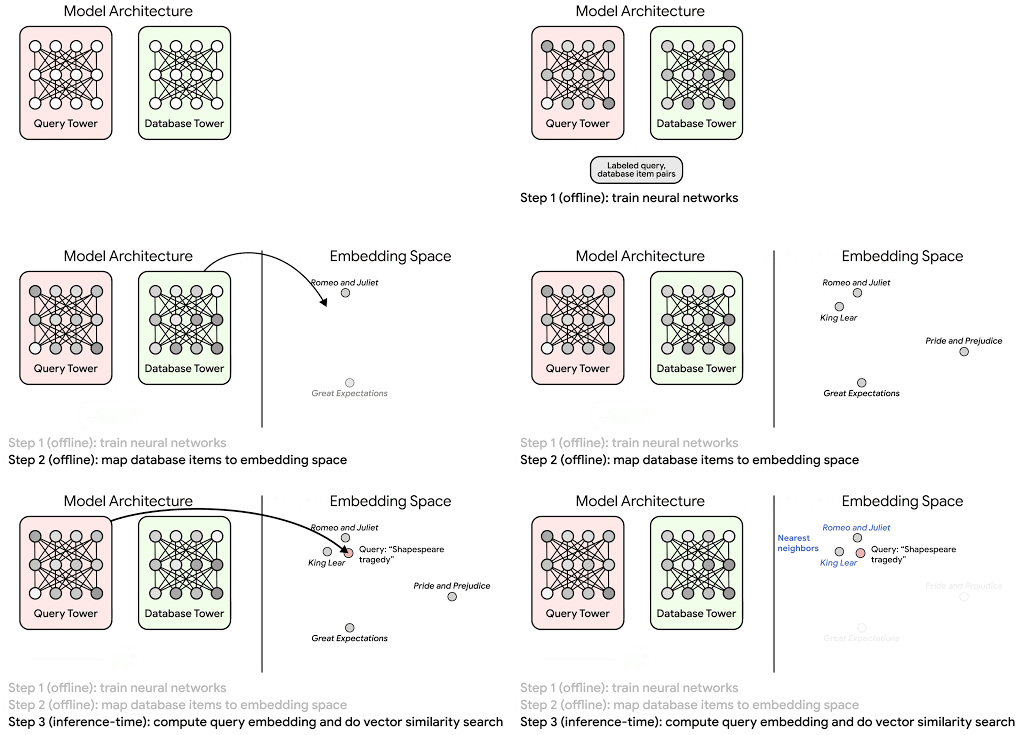
Both towers need to produce vectors in the same shared vector space. That way, you can measure the relevance between a query and a document with simple metrics like the "dot product" (which Google uses for efficiency) or cosine similarity. The higher this similarity, the more relevant the document is for that query. The clever part is that the two towers are trained together to maximize the similarity between queries and their relevant documents, while minimizing it for irrelevant documents.
Imagine that every text or sentence becomes a point on a vast "map of meanings". On this map, similar concepts like "automobile" and "car" sit very close to each other.
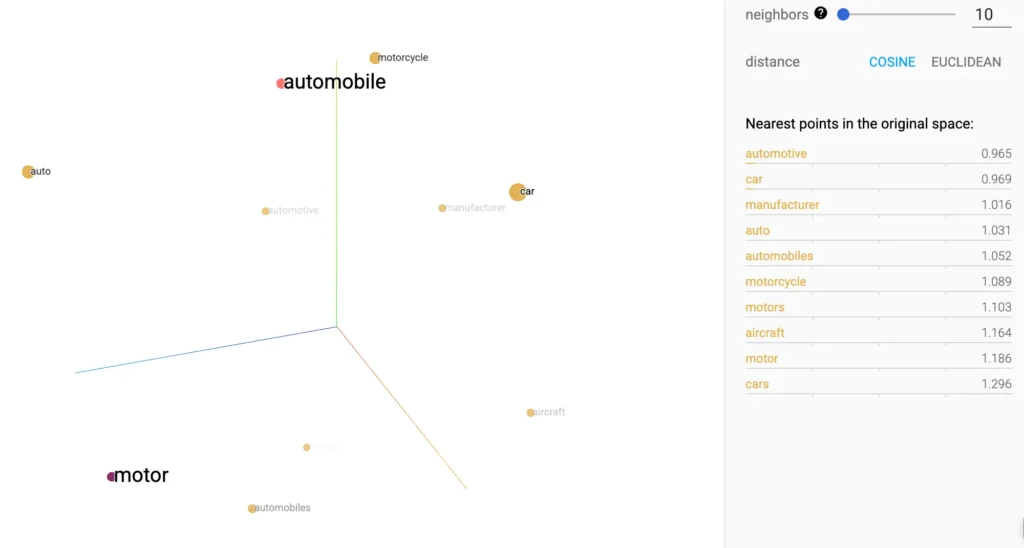
- The good thing about semantic search is that it's exceptional with natural language. It lets a search for "clothes for young people" find results that talk about "teen fashion", because the system understands semantic generalization.
- The bad thing about semantic search is that it fails with terms that have no conceptual meaning or that are too specific (what's known as "out-of-domain" data). For example, a product code like "SKU 8-XYZ-45" is just noise to this system.
For the curious: Two-Tower embeddings produce a single vector per document, but searching across millions of them requires specialized indexes:
- HNSW: Builds multi-layer graphs for fast navigation. Used by Weaviate and Qdrant.
- ScaNN: Asymmetric quantization optimized for billions of vectors. Google uses it and now offers it in Vertex AI
- FAISS: Combines clustering (IVF) with compression (PQ). Meta's choice. I use it in tricky SEO migrations.
- Annoy: Uses random binary trees. Simpler, but effective for medium-sized datasets. Spotify's pick.
These indexes make it possible to search across a billion vectors in milliseconds, and they're the invisible engine behind all semantic search.
3. Hybrid search
Since neither of the two approaches above is perfect, the best solution is to combine them through hybrid search.
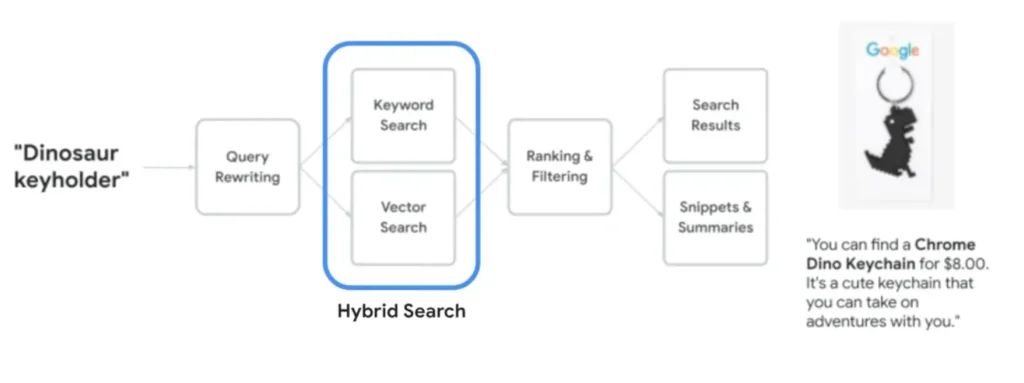
Hybrid search is a system that takes advantage of both the lexical similarity of keyword search and the semantic similarity of vector search. It has become an essential part of modern information retrieval systems, and it's also used in Retrieval-Augmented Generation (RAG) applications.
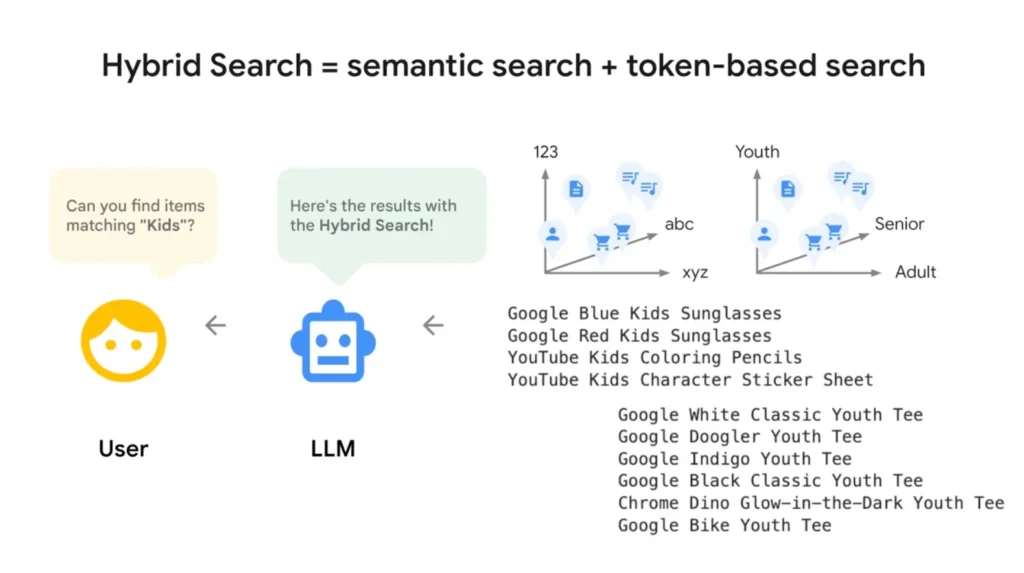
Google Search is the most famous example of a hybrid search engine. With the introduction of RankBrain in 2015, Google added a powerful semantic layer to a system that was already (too) good at finding exact words, creating a large-scale hybrid system. As a reminder, RankBrain is an artificial intelligence system that helps Google understand the connections between words and concepts. This means Google can show more relevant content even when that content doesn't include the exact same words as the search, because it understands that the content is related to other terms and concepts.
How are the results combined? The role of Reciprocal Rank Fusion
When you have two lists of results (one semantic, one lexical), you need a smart way to merge them. The most common solution is Reciprocal Rank Fusion (RRF).
RRF works in a very simple way: instead of trying to compare the relevance scores of each system (which aren't compatible), RRF only looks at the position (the rank) a document holds in each list. A result that ranks well in both lists gets rewarded and rises to the top of the final ranking.
Modern systems like Google Vertex AI add an alpha parameter (0 to 1) to control the weight between semantic and lexical search before applying RRF. With alpha=1 you only use semantic search, with alpha=0 only lexical (typically 0.5 to give both equal weight).
In ChatGPT, the code leaked by Metehan Yesilyurt shows rrf_alpha: 1, but note that this is a different parameter: it doesn't control the semantic/lexical balance of retrieval, but the weight each list gets when it enters the RRF formula in the fusion stage. With a value of 1, all lists (semantic and lexical) go into the fusion step with equal weight. In ChatGPT, the semantic vs. lexical balance is decided in other layers of the pipeline, not here.
Fun fact: the file_search tool, which works on the user's files and connected sources (Dropbox, Notion, SharePoint), explicitly instructs:
> 'You should build well-written queries, including keywords as well as the context, for a hybrid search that combines keyword and semantic search'
And it goes further: it defines two available lexical operators, + to boost exact terms and --QDF= to signal the desired freshness. In other words, in its own internal infrastructure, OpenAI doesn't just combine semantic with lexical, it also provides explicit tools to force an exact match when needed.
Methods like BM25 (lexical) and vector search (semantic) produce scores on completely incompatible scales, so adding them up directly makes no sense. RRF solves this by relying only on position, which makes it stable and resistant to outliers.
RRF is a basic building block of any AI system that uses RAG, like AI Overviews, AI Mode or ChatGPT. As a reminder, RAG is the process by which an AI, before answering, first "searches" for information in a database so it can base its answer on facts. Hybrid search retrieves the documents, and RRF orders them so the AI knows which ones matter most. This process, also known as "grounding," is what's meant to stop the AI from making things up. As we discussed in the article about the ChatGPT leaks, systems like ChatGPT also use RRF internally to improve the relevance and coherence of their answers.
A public example with real numbers comes from Anthropic. In their article on Contextual Retrieval (September 2024), they explain how to build a RAG system that combines embeddings and BM25, fuses the results by rank and then applies re-ranking. It's the same architecture we've seen in this article. What they add is that, before each chunk is indexed, an LLM writes 50 to 100 tokens of context about the document the chunk comes from. For example, the chunk "The company's revenue grew by 3% over the previous quarter" now also says which company and which quarter it refers to.
The results are impressive. With contextual embeddings, the number of relevant documents left out of the top 20 drops by 35%. Add contextual BM25 and it drops by 49%. Add re-ranking and it's 67%. They also explain why the lexical part is still needed: if someone searches for "Error code TS-999", an embedding finds content about error codes in general, while BM25 finds the exact code.
Keep in mind that this is a guide for developers building their own RAG. It doesn't explain how Claude searches the web. But it confirms two things: that hybrid is also the standard in RAG, and that a chunk without the context of its document is harder to retrieve. It's the same thing I explain in chunking content for AI.
4. Multi-stage search
In the most advanced systems, from Google to generative AI engines, the process doesn't end with fusion. They run on a two-stage (multi-stage) architecture so they can be both fast and accurate:
- Retrieval: The first stage is about quickly finding a broad set of potentially relevant candidates among billions of documents. This is where hybrid search comes in, combining lexical and semantic results with RRF. Speed is the top priority.
- Re-ranking: The second stage analyzes only that set of candidates in detail to order them as precisely as possible. Here the priority is the quality of the result.
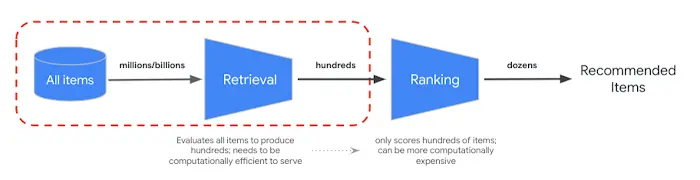
Now let's look at the specific technologies and models used in each stage.
Retrieval
To be extremely fast, this stage uses hybrid search, combining lexical search (keywords) and semantic search (meaning). This is where technologies like ColBERT and PLAID come in, and they're very likely the ones Google has in production. Not Muvera, as I explain here.
- ColBERT: Unlike traditional Two-Tower semantic search, which creates a single vector for the whole document, ColBERT is much more granular. It creates a vector for each word and then, at search time, compares each word in the query with each word in the document. This method, called "late interaction," gives it much higher precision right from the start. While Two-Tower is faster but less precise, ColBERT trades some speed for higher semantic precision.
- PLAID: ColBERT's method is very powerful but computationally expensive. PLAID is an indexing engine designed specifically to solve this problem in ColBERT. It organizes ColBERT's vectors in an ultra-efficient way, so those complex word-by-word comparisons can run at incredible speed.
- FastSearch: A proprietary technology that Google uses internally for its Gemini models. It's based on RankEmbed signals and is designed to quickly generate an abbreviated set of highly relevant organic results that an AI model can use for "grounding". I think it could rely on one of the two technologies above, and that it could be what's used in AI Overviews and AI Mode. FastSearch delivers results faster than full web search because it retrieves fewer documents, though at the cost of slightly lower quality. Google doesn't offer it directly to third parties. Instead, it's built into its Vertex AI product, where customers get the information from the results through its API, but not the ranked results themselves, to protect Google's intellectual property.
Re-ranking
Once the retrieval stage has handed us a few hundred good candidates, it's time to bring out the heavy artillery to put them in their final order. This is where large language models come in. They're too slow for the first stage but perfect for this detailed analysis.
- BERT pioneered understanding the context and nuances of all the words in a sentence. It's a high-precision "context analyst" used at this stage to check whether a candidate document really answers the specific intent of the query.
- MUM is the next step. It's a much more powerful model that not only understands text more deeply, but is also multilingual (it can use knowledge from several languages) and multimodal (it can understand the relationship between text and images). It's like a final judge that can use a much wider range of signals to decide on the best result. But Google says it only uses it for featured snippets, related topics in videos, Google Lens and a few other features.
- T5 and other LLMs: At this stage, they can be used for very sophisticated tasks, like generating an "ideal" summary of the answer and scoring candidates by how closely they resemble that ideal.
This two-stage process lets systems deliver results that are both instant and extremely relevant. But we can't forget about diversification. Production systems apply algorithms like MMR (Maximal Marginal Relevance) or xQuAD to avoid redundancy. If the top 5 results basically say the same thing, MMR penalizes them and pushes up complementary content. This is especially critical for AI Overviews and RAG, because if you feed an LLM 5 identical documents, you waste valuable context. MMR would make sure each document brings unique information, covering different aspects of the query. Google almost certainly does this, which is why you see varied results even for ambiguous searches.
5. Bing's case: from dense-sparse to semantic-first
All of this sounds great, but has anyone actually shown what's under the hood in public? Yes, Bing, in a 2021 talk. Its engineers (including Knut Risvik) walked through their dense-sparse architecture, which is exactly the multi-stage hybrid we've been talking about, laid out in the following diagram.

The example they used was the query "Tarantino's ninth movie", and the flow has three stages:
- Parse: the query is turned into both an execution tree for the classic (sparse) index and a vector for the semantic (dense) space, at the same time.
- Search: the sparse side matches against posting lists with BM25f and the dense side does ANN matching in the vector space, in parallel. They're not looking for the same thing. They complement each other to widen the matching space.
- Score: both lists converge into a universal ranking that combines BM25f (lexical) with vector similarity (semantic) in its L2 layer, and on top of that it applies L3/L4 re-ranking with extra signals like the user's location.
In other words: parallel hybrid retrieval + layered re-ranking. The same thing we've seen, but without the speculation 🙂
One nuance: it looks like Bing doesn't fuse with RRF. Instead of looking only at positions, it feeds BM25f and vector similarity as signals into its universal ranker, which is another way to sidestep the problem of adding up incompatible scores that we saw with RRF. Pure RRF as we know it is what you find in Vertex AI or ChatGPT.
And the vector index? Bing's is called SpaceV and it runs on the SPANN algorithm, a hybrid memory-SSD index designed to hold hundreds of billions of vectors, respond in single-digit milliseconds and update tens of billions of vectors a day with no downtime. It's the web-scale cousin of the HNSW, ScaNN and FAISS indexes we saw earlier.

2026: the jump to semantic-first
Five years later, the same Knut Risvik is behind Web IQ, the grounding system Microsoft presented at Build 2026. And here's what's new: the stack goes semantic-first. Dense no longer runs in parallel with lexical. It becomes the default access path in the first stage, and lexical (exact match) moves downstream to recover precision only where it's needed. So they don't get rid of hybrid, they reorder it.
The funny thing is that the 2021 deck already saw this coming in its slide about the future: it talked about "learning to index" (moving from the classic inverted index of the '70s to models that learn what to index) and about a "single fusion model" that would generate the vector search and feed the classic index at the same time. Web IQ is that path made real.
The late interaction we saw with ColBERT stops being just one more piece of hybrid retrieval and becomes the starting point of the stack.
Don't mix up the indexes, though: the 2021 SpaceV/SPANN and the DiskANN that Web IQ mentions in 2026 are both Microsoft disk-based ANN indexes, but they're different algorithms (SPANN partitions into clusters, DiskANN is graph-based). Same family, different implementation.
Technical note: This article simplifies complex concepts to make them accessible. Real production systems combine these techniques in proprietary ways that aren't always documented. The specific implementations of Google, OpenAI, Bing and others are largely speculative, based on public papers and observable behavior.
Related articles:
What the ChatGPT Leaks Teach Us About SEO for AI
Can You Do SEO for Muvera? Is the Muvera Update Real?
What the ChatGPT Leaks Teach Us About SEO for AI
Google’s Algorithms Uncovered: How the Search Engine Works According to Leaked Documents
