In this post I'm going to give you a set of must-have semantic SEO resources that you really need if you work in SEO and want to evolve as search engines move toward the semantic web. I hope you find them useful, and that at the very least it becomes clear that semantic SEO is much more than structuring data or using HTML5…
Many of the resources I'm about to share are far more complex than average, but the thing is, our job requires knowing which algorithms search engines use at each stage, or at least having a rough idea of them. Wrestle with them and I promise you'll get a lot out of them.
You're not an SEO if you don't know how a search engine works
In my previous post on entities I already said that, in my opinion, you can't be an SEO professional if you don't know how a search engine works. And I don't just mean knowing the stages, as in "first a search engine crawls, then it indexes, and then it ranks at query time; I saw Matt Cutts say it in a video":
Because knowing that is SEO 101 (and in this PDF Matt Cutts explains the same thing for the SEO 101-and-a-half crowd). At each stage, search engines use, combine and improve hundreds of algorithms so they can answer our questions. Want to know a secret? Semantic components are already built into every stage.
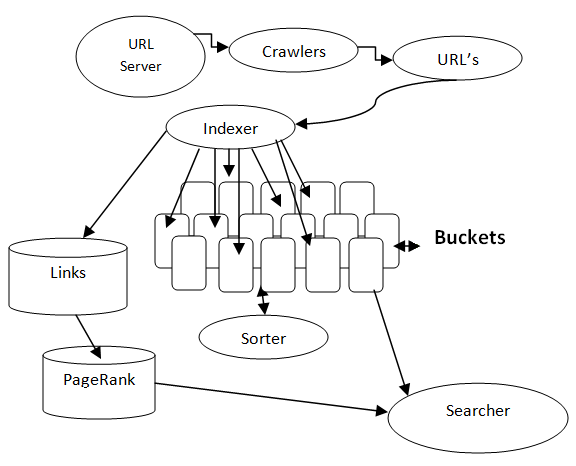
Basic diagram of a search engine
Once you understand how search engines use these semantic components to extract, classify and retrieve information, you get a different perspective and a more realistic picture of what an SEO's job really is today.
That job is getting harder and harder to boil down to a set of parameters, because it's directly tied to people's information needs and to how Artificial Intelligence applied to linguistics can meet them (personalized, predictive, conversational and semantic search). The same goes for CRO, where there's no checklist because every project is different.
SEO is no longer a checklist
And I'm telling you this from experience: the more I learn about search engines, the better results I get and the less I'm flying blind. On the other hand, I'll also tell you that the more I study and put what I learn into practice, the more I realize how little I know.

In the past I've made optimizations that I later realized were actually unnecessary over-optimizations, and in some cases even counterproductive (forgive me, Father, for I have sinned). I've also added and removed things just because they showed up on a list of reverse-engineered ranking factors, but correlation does not imply causation. And some of these factors are just rumors that spread because some guru's chakras lit up.
In Spain I know hardly any SEOs who are interested in information retrieval and extraction (IR and IE), the real foundations of SEO. That's why I hadn't felt motivated to write about it until now, but seeing how well my post on entities and SEO was received, I think there's more interest than I expected.
From linked pages to connected entities
Information extraction in particular has been getting more and more important since Hummingbird arrived, and it's gaining even more momentum now that Google has made its new knowledge graph, the Google Knowledge Vault, official.
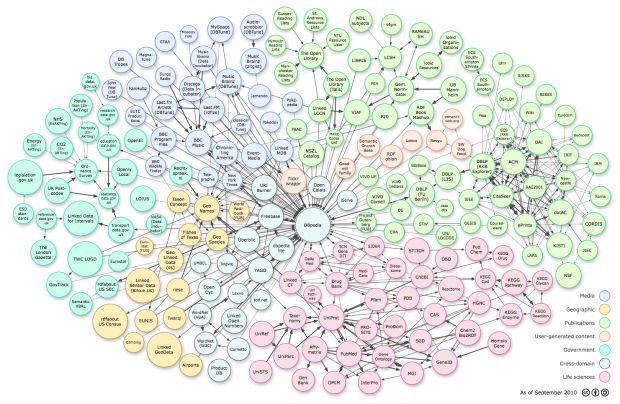
I think this announcement is very interesting because it's something people have been talking about for a long time: Google's transformation from a search engine into an answer engine. It's a paradigm shift in how we understand SEO, where algorithms focused on pages and their relationships, which are easy to manipulate (PR, HITS, TrustRank, Okapi BM25, Tf-idf…), will carry less weight.
As information extraction methods evolve, keywords, anchors and links will become less and less necessary. So the framework we've been working with changes completely.
Semantics in the 3 pillars of SEO
Now let's look at some examples of how semantics is present in the three core pillars of SEO: Authority, Content and Architecture.
Authority
To do link building, you need to know how search engines interpret links and anchor text in their algorithms. This goes way beyond just doing tiered link building, which has become trendy lately (even though people have been doing it for years), and throwing in X percent of anchor variations. I only know one link broker who takes into account the semantic concepts search engines use to rank (and that's why they're the only one I hire). You do link building and you've never cared about this? Do you know about co-occurrence? These days relevance carries more weight than authority. You'd save yourself a lot of work and keep your chances of getting penalized to a minimum.
Content
To write optimized content, it's not enough to put the keyword in all the usual, well-known places and repeat it, because that doesn't work as well these days (and it will work less and less). Search engines are focusing on entities and their relationships rather than on the keyword itself. What I mean is that you can make an article much more relevant to a topic in the search engine's eyes without repeating the same word, even without that word appearing in the key places. And I'll go further: the word you want to rank for doesn't even need to appear.
Often you wouldn't need to add more content to be more relevant. You can do it by creating more relationships that help disambiguate the entity, "connecting the dots" 😉
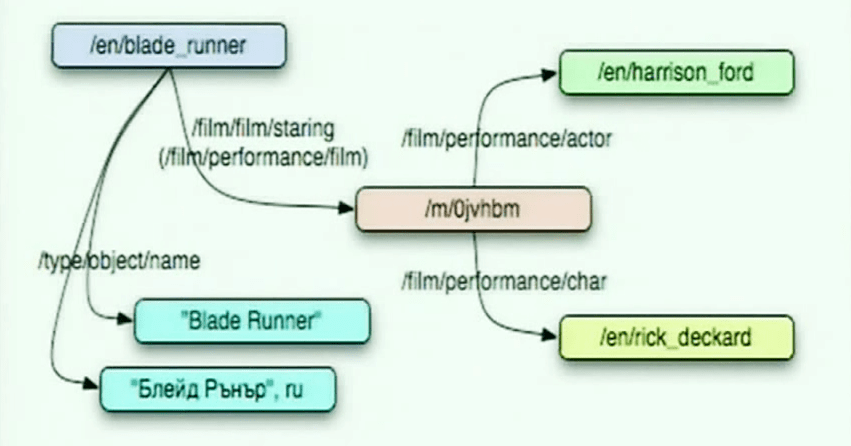 Related entities in Freebase
Do you know how search engines work out semantic relationships? Do you know what word sense disambiguation is? Or how Google parses HTML elements to extract meaning? You'd end up with text that's 100% written for people and 100% understandable by search engines. You can make your pages accessible, but if you don't make them semantically understandable you're wasting your time.
Architecture
On the technical side, you need to understand how search engines crawl your site so you can optimize the crawl budget you've been given, and how they interpret your site's structure, among many other things. For example, do you know how Google renders a page to detect the different regions of a document? How Bing does it? Or Yahoo? Or how Google extracts taxonomies to understand site architecture? You'd get a structure that's much more relevant to search engines and avoid over-optimizations you thought were necessary.
These are just a few examples (and believe me when I say they're only a few) of what you're missing out on if you don't understand how search engines do information retrieval and extraction (IR – IE). When you study these fields, you realize we can help search engines learn faster and understand you much better by saving them work, which, at the end of the day, is our job as SEOs. How many of these things show up in the famous checklist of 200+ ranking factors? None of those factors talk about how to apply natural language to our projects. This goes way beyond the keyword.
Semantic SEO for the structured web is here to stay
Besides the links I've dropped throughout the post, I'm going to recommend a few more resources that are well worth your time if you work in SEO and, above all, if you want to keep doing it in the years to come, because as the web evolves, SEO has to evolve too:
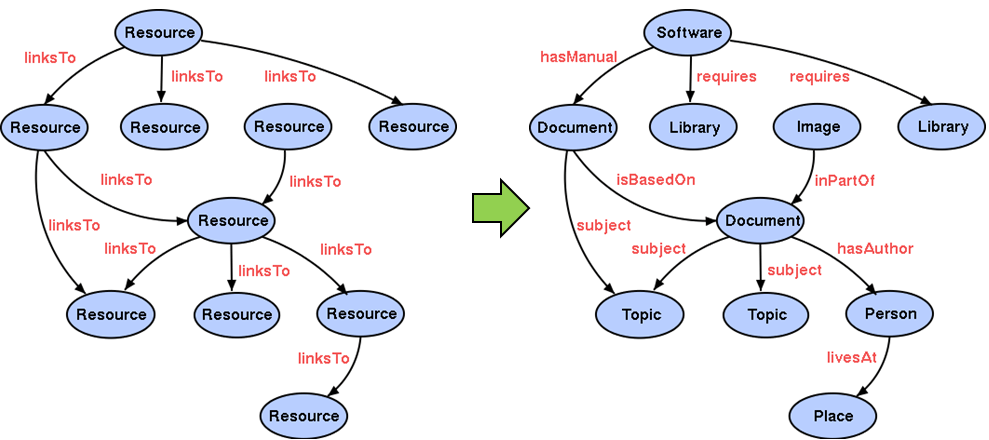 Current web vs. semantic web
Book: Modern Information Retrieval by Ricardo Baeza-Yates and Berthier Ribeiro-Neto
I bought this book after seeing Ricardo Baeza-Yates (VP of Yahoo Labs) speak live at the Search Congress in Barcelona a few years ago. It's a very dense book, but a real eye-opener and a must if you work in SEO. Besides teaching you the true foundations of SEO, the book has chapters dedicated to information extraction. Here are the teaching slides based on this book:
- Introduction (34 slides)
- User Interfaces for Search (87 slides)
- Modeling (263 slides)
- Retrieval Evaluation (144 slides)
- Relevance Feedback and Query Expansion (104 slides)
- Documents: Languages & Properties (147 slides)
- Queries: Languages & Properties (67 slides)
- Text Classification (157 slides)
- Indexing and Searching (153 slides)
- Parallel and Distributed IR (138 slides)
- Web Retrieval (163 slides)
- Web Crawling (91 slides)
- Structured Text Retrieval (135 slides)
- Multimedia Information Retrieval (164 slides)
- Enterprise Search (128 slides)
- Library Systems (35 slides)
- Digital Libraries (58 slides)
- Open Source Search Engines (25 slides)
Book: Feature-driven question answering with natural language alignment by Xuchen Yao
This book is a recent PhD dissertation by Xuchen Yao (a 332-page PDF). Yao interned at Google Research in 2013, working on Question Answering (Q&A). The dissertation covers 50 years of Q&A history. It also explains how Q&A is done over structured data for queries that aren't written in natural language (basically, the way we search on Google).
Presentation: Bringing Structure to Text: Mining Phrases, Entity Concepts, Topics, and Hierarchies
This KDD 2014 presentation covers the different techniques used to extract and connect information, which search engines are using today. Some of the slides are pure gold 🙂
Presentation: Semantic Web and Schema.org
A presentation given at SemTech 2014 by Google engineer Ramanathan V. Guha. It explains why Schema needed to be created and what it's used for. I'm also sharing this article, which shows things you couldn't do with Schema structured data until recently.
Presentation: SEO and the Semantic Web by Lakil Essady
A presentation my business partner and friend Lakil Essady gave at Congreso Web (a Spanish web conference). It's from 2011, but it's just as valid today, and it's one of the few things you'll find in Spanish about how SEO ties into the Semantic Web.
Video: Introduction to NLP (natural language processing)
The video is an introduction to NLP (IE relies on it) that walks through the state of the art in this field of artificial intelligence and linguistics.
Video: The Structured Search Engine
This 2011 video is from a Google Tech Talk where Andrew Hogue, one of the inventors of the Data Janitors, explains how hard it is for search engines to extract parts and information from within a document, and how close they get to solving the problem.
The video also covers the synergies between Freebase and Google a few months after the acquisition. We're talking about a video from a year before the Knowledge Graph, and now we're already living in the Knowledge Vault era. But that doesn't stop it from being a good introduction to sentiment analysis, query parsing and question answering in search interfaces.
My favorite line from this video: "20 million entities is cool. You know what's really cool? A billion entities." And he hinted at it again at Strata in New York, where he said that one way to know the answer to everything is to have a bigger database or build hybrid systems (the KV we know today).
Conclusions
At the start I said you're not an SEO if you don't know how a search engine works. The truth is, nobody knows how search engines work, because we're talking about solving a problem with probabilistic models: nonlinear programming! So not even Google's own engineers really know what the whole algorithm does and how much weight it gives each part, because that's impossible.
All we know is that there are small algorithms used in certain parts of the overall logic. Knowing them will give you a rough idea of how the whole thing works, which is a lot better than knowing nothing, and you'll stop doing things just because everyone else does them.