I’m writing this post because I’m tired of reading more and more nonsense about SEO and HTTPS (Hypertext Transfer Protocol Secure) after Google’s announcement on its blog, “HTTPS as a ranking signal”. But it didn’t all start there. The buzz began picking up steam in the SEO world in March 2014, when Matt Cutts said at SMX that he’d “love for HTTPS to be part of the ranking algorithm this year” (although people have been talking about it for three years).
Three months later, Pierre Far (Webmaster Trends Analyst at Google) and Ilya Grigorik (Developer Advocate for Google Chrome) gave a talk at Google I/O called “HTTPS Everywhere”, which already made it clear that a global change in search was on the way.
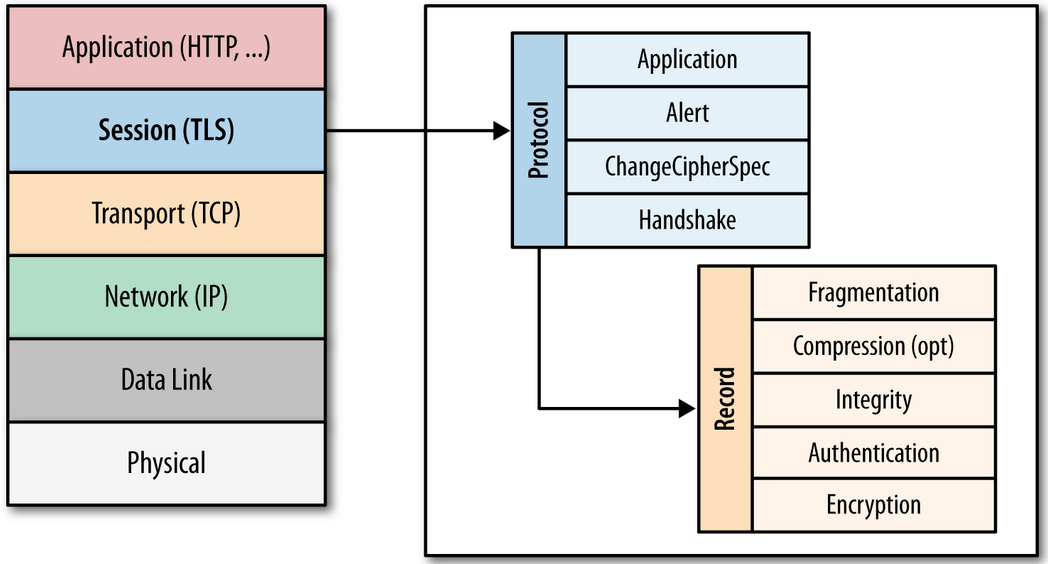 High Performance Browser Networking – Chapter 4. Transport Layer Security (TLS)
HTTPS, as the name suggests, is simply the secure version of the HTTP protocol, and it’s used to protect private data in transit (passwords and personal details). The protocol creates an encrypted channel between the client and the server, so the data stays encrypted in case an attacker manages to intercept it. So, at first glance, it has little to do with search engine rankings.
It’s not very common for Google to make this kind of announcement, since it doesn’t usually say what works and what doesn’t in its algorithm. But if you stop and think for a second, the move is obvious…
Google thinks it IS the Internet. Just as it breaks the rules of the Internet by penalizing sites that don’t link the way it likes (all because its algorithm is ineffective), it also wants to force every website to use secure encryption. I’m not sure whether that’s to protect users or whether there’s something else behind it (conspiracy mode on: Google Domains + SSL). And what’s the best way to rule the Internet however you please? Tell SEOs that if they make the switch, they’ll get a reward in the SERPs.
The problem, as always with this kind of announcement, is that people then interpret the words however they want, or however they can. If you read the announcement, all it says is that they’ll use TLS encryption as a very lightweight positive signal (it has only affected fewer than 1% of searches) and that it will probably carry more weight over time.
First, it says it’s a signal, not a factor, and it’s certainly not meant to penalize anyone. Second, it says it’s lightweight, since it affects fewer than 1% of queries (many other signals carry more weight, like TTFB). And finally, it doesn’t say which kinds of searches were affected: transactional? informational? navigational? multimedia?
Pierre Far himself said on Hacker News that he was personally involved in the change. And he wanted to make it clear that HTTPS is just as important for informational sites, for two reasons:
- Data integrity: To avoid being hacked and having someone tamper with our content.
- Authentication: To identify the people behind websites.
Well, I don’t think either reason holds up. With the first one, Google is once again making it clear that it has trouble detecting hacked sites (its algorithm is ineffective, yet again). And the second one is completely false! When you order an SSL certificate, they ask for your details just like when you register a domain, and you can make them up, same as always. Unless you get an EV (Extended Validation) certificate, where they check everything, right down to what time you go to the bathroom.
So, going by what Pierre said, it looks like the change will also affect informational sites. Personally, I don’t think HTTPS encryption makes sense beyond sites where users have to enter their data, like an ecommerce store (and not even in every section of it). Honestly, I just don’t see the point for informational sites, and I agree with what Bill Slawski said on Twitter: “my blog will still have the same content on a secure server”.
Another thing we know, from John Mueller himself, is that the change will apply to URLs that have HTTPS enabled, and those are the only ones that will benefit in the algorithm. So, in short, this change will affect all kinds of sites, but only the URLs on a site that have HTTPS enabled, which means encryption has to be rolled out across the entire site.
Media outlets spreading misinformation about HTTPS and SEO
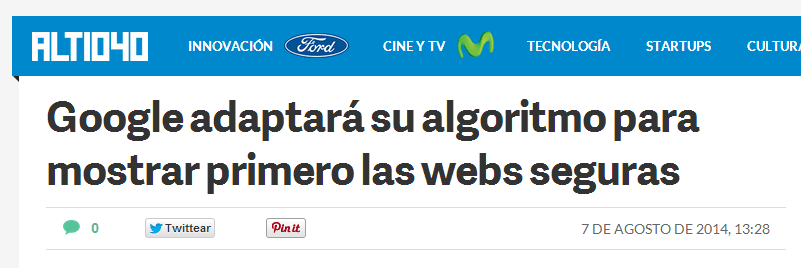
From then on, plenty of major media outlets and blogs (plus other SEOs who only read headlines and retweet like there’s no tomorrow) started shamelessly twisting the facts about SEO and HTTPS. Among them are The Guardian, VentureBeat and the Spanish-language tech sites Genbeta, Trecebits and Alt1040:
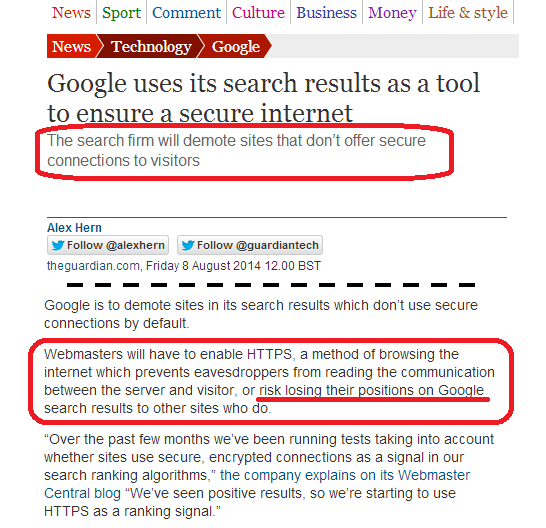 The Guardian
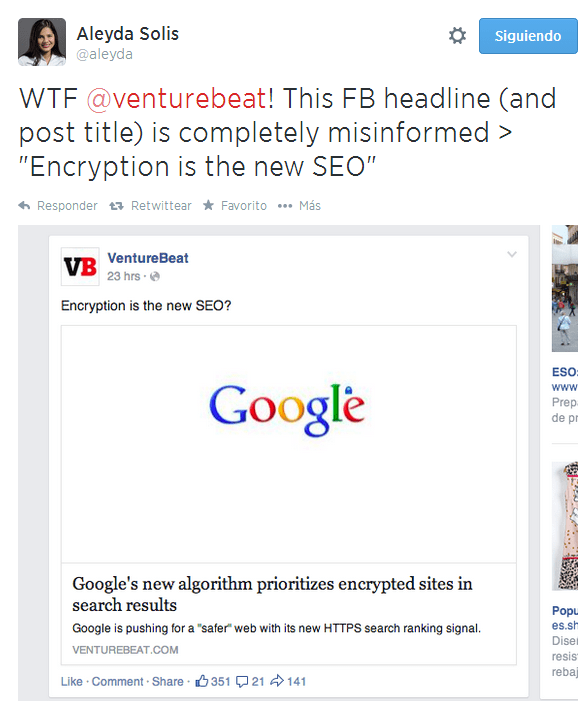 VentureBeat – Source: Aleyda Solis
 Genbeta – Source: Jaime Cuesta
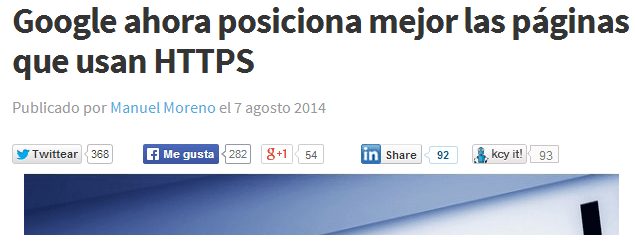 Trecebits – Source: MJ Cachón
 ALT1040
As you can see, there’s a big gap between what Google says about the impact on rankings and what these misinformation outlets are saying. And worst of all, this misinformation creates fear, and that fear is used to hurt businesses and professionals who don’t know much about the subject. Below you can see an opportunistic hyena (with apologies to hyenas, who aren’t to blame) claiming that “Google REQUIRES SSL for SEO” and offering packages like “high level security certificates SEO Excelence level Google Green Toolbar”, among others (seriously, what were they smoking?):
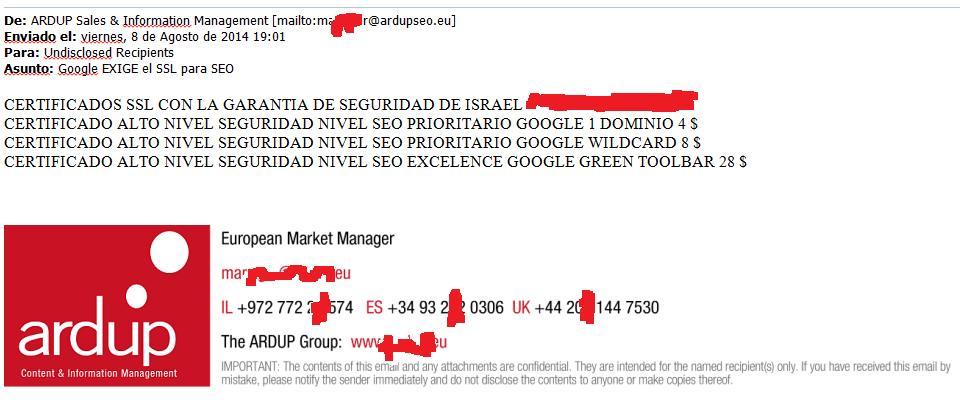 Source: http://e-andorra.eu/
But these guys don’t stop there. They also offer “official Google SSL certificates” with no installation on the server (an iframe? WTF), claiming that once you have one, you’ll start getting hundreds of links from other sites with the same “official SSL”:
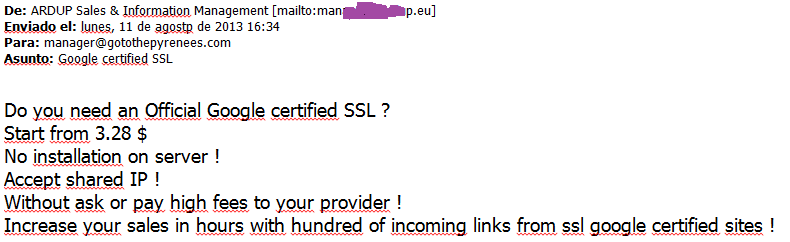 Source: http://e-andorra.eu/
You might think nobody could possibly believe this, but nothing could be further from the truth. Here’s a conversation between e-andorra (my hosting provider) and a customer:

This guy wants to buy secure servers to do SEO for his clients, and he seems completely convinced. Oh well. Jan from e-andorra tells me that loads of customers are asking him for SSL for rankings, not for security…
SEO implications of an HTTP to HTTPS migration
Few people know what this change involves on the development side, or that if it’s done badly it can hurt your SEO quite a bit. And even if it doesn’t seem like it, switching to HTTPS is harder and riskier for big companies than for small ones. I also think that, as of today, the cost of implementing this secure protocol is higher than any benefit you might get in search engines.
Making the switch means load times will go up (bad for SEO), and your infrastructure has to be able to handle it (caching, CPU…). And let’s not forget that this is a migration, with everything that implies for SEO (301s, canonicalization, telling Google about the move in Google Webmaster Tools…), where you can really mess things up if you don’t know what you’re doing. To make matters worse, Webmaster Tools isn’t ready for the change yet… Another thing to keep in mind is that not every encryption level will do: Google recommends 2,048-bit keys.
Lots of people have already switched and started losing traffic because they did it wrong. Others have done it right and haven’t noticed any change in rankings. Only one person I know has told me it did have a positive effect, but I still need to analyze the whole case (I think it’s down to the server change). And as always, before recommending this migration to a client just for the sake of it, I’ll test it first.
Here’s a Searchmetrics study showing that there’s no relationship between rankings and SSL certificates:
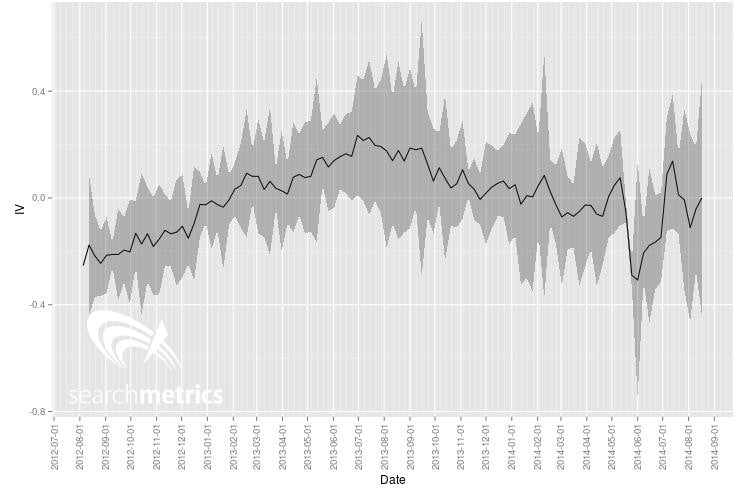 No relationship between rankings and SSL encryption – Source: Searchmetrics
To make matters worse, Google’s own products aren’t “secure friendly” yet, so if you run AdSense you may be losing revenue (as I’ve already read in several places), Google’s Trusted Stores isn’t ready for the change yet, and neither is Webmaster Tools…
If you want more information, here’s John Mueller discussing the implications, and here’s Jan-Willem Bobbink explaining what can go wrong in an HTTP to HTTPS migration. And if you want to dig deep into SSL/TLS, here’s the chapter Google’s own Ilya Grigorik wrote on the subject in his book: Transport Layer Security (TLS).
Changing their tune
The funniest part of all this is hearing Matt Cutts in May 2011 saying that he doesn’t see the point of moving a site to HTTPS unless it’s necessary! And that if you do it, you should do it very carefully, testing it on small sections of your site, because it could cause ranking problems:
OK, fine, it’s from 2011, and Internet years are like dog years. But what do you make of John Mueller in February of this year saying that migrating to HTTPS does NOT affect rankings? Should we laugh or cry?
Google Domains + SSL: the real reason?
Everything Google does, it does for a reason, and always with the goal of filling its coffers at the expense of “privacy”. As I mentioned at the start, there has to be something else behind this. After launching Google Domains (still in beta), the Silicon Valley giant could start offering free SSL encryption along with its domains (that's what TechCrunch is suggesting). As you know, the money isn’t in selling domains. The real business is all the upselling that comes afterward: hosting, CDN, encryption…
But the monopoly conspiracy doesn’t end there! Coincidentally, right after stirring up all this fuss, Google started emailing people who had signed up for the beta to tell them they now had access to Google Domains…
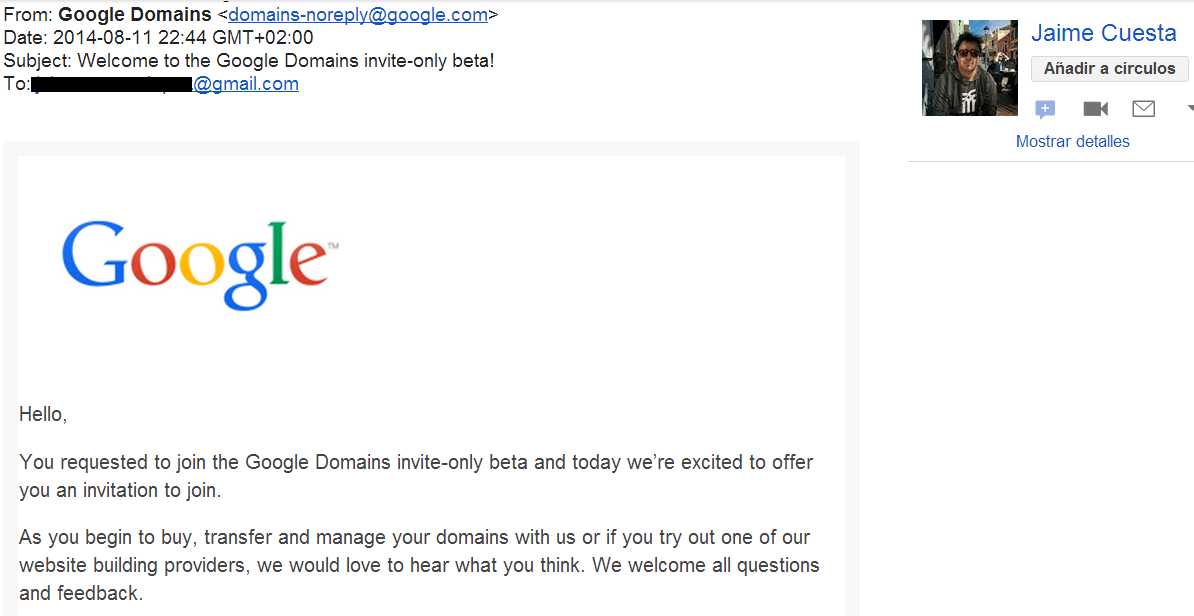 Google Domains beta access – Source: Jaime Cuesta
Shall we keep going with the conspiracy? Earlier I mentioned that sites using TLS are slower. Well, the search engine has that covered too, because Google has its own protocol to fix it: the well-known SPDY, which solves this TLS problem by making fewer connections and using fewer resources and less memory, as Spanish SEO Señor Muñoz explains. That way, we’d be handing Google even more data… And that’s not all: just a few days before the much-quoted announcement, Google obtained a patent to speed up SSL connections.
Hey, wait, there’s more! Google and Symantec have had a close relationship for years. Look how much Symantec’s SSL market share has grown this year:
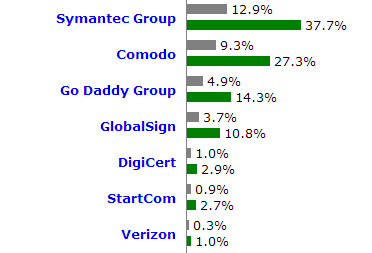
Jan from E-Andorra tells me that Symantec has improved its partner commissions, up to 30% depending on SSL sales volume, starting at $12,000 in sales per month.
“Don’t be evil”? Draw your own conclusions.
Your users first, SEO second
Conspiracies and monopolies aside, don’t forget that SSL is just one more signal among all the ones you need to work on, and right now, if it carries any weight at all, it’s minimal. So if you decide to make the switch, do it so your users are, and feel, safer on your site, not for SEO. As I said in my previous article, users are the foundation of your business and come before SEO. And the media could learn this lesson too, because it’s very hard to win back your credibility once you’ve lost it in your hunger for traffic at any cost.